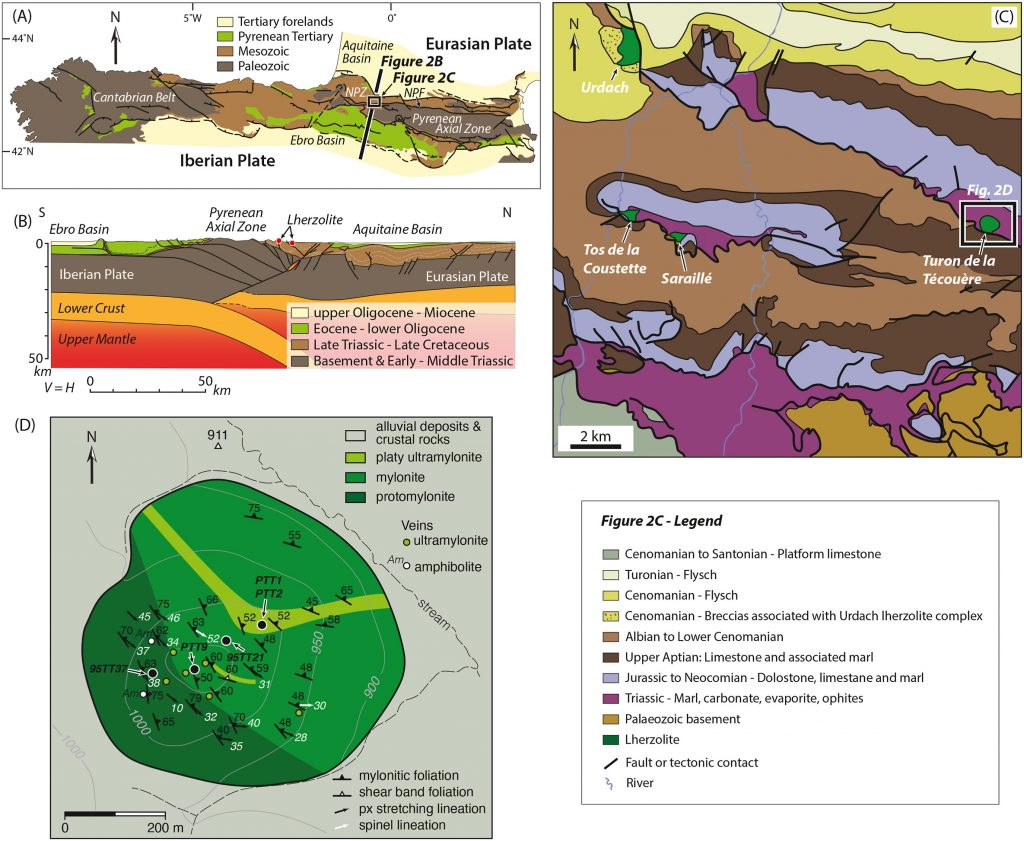
This study shows that constant displacement rate conditions – imposed by plate tectonics – is the best approach to consider the evolution of extensional plate-boundary shear zones, as stresses vary during deformation. The Turon de Técouère massif of the French Pyrenees preserves a Cretaceous, magma-poor hyperextended plate margin within the lithospheric mantle. The massif exposes an extensional shear zone hosted in lherzolite. The present-day structure of the shear zone, frozen at 750 °C, consists of a ∼40 m thick ultramylonite, bordered by a ∼200 m thick mylonite and a protomylonite >100 m thick. The ultramylonite overprinted a ∼40 m-thick mylonite that was active between 1000 and 850 °C, while the shear zone became thicker with time. Using displacement rates, determined from tectonic analyses, and strain rate estimates, determined from microstructural analyses, the calculated thickness (8–20 m) of the shear zone is less than the observed thickness (40–200 m) at different temperature conditions experienced by these rocks. Therefore, the shear zone is thicker than necessary to accommodate the plate motion. This result indicates that the Turon de Técouère shear zone likely represents the entire divergent plate boundary at conditions of the lithospheric mantle. We introduce the concept of a “jump around” shear zone – in which a smaller zone of active shearing moves around within a thicker zone of deformation – to explain the discrepancy between the thinner shear zones predicted by strain rates and the thicker observed shear zone.