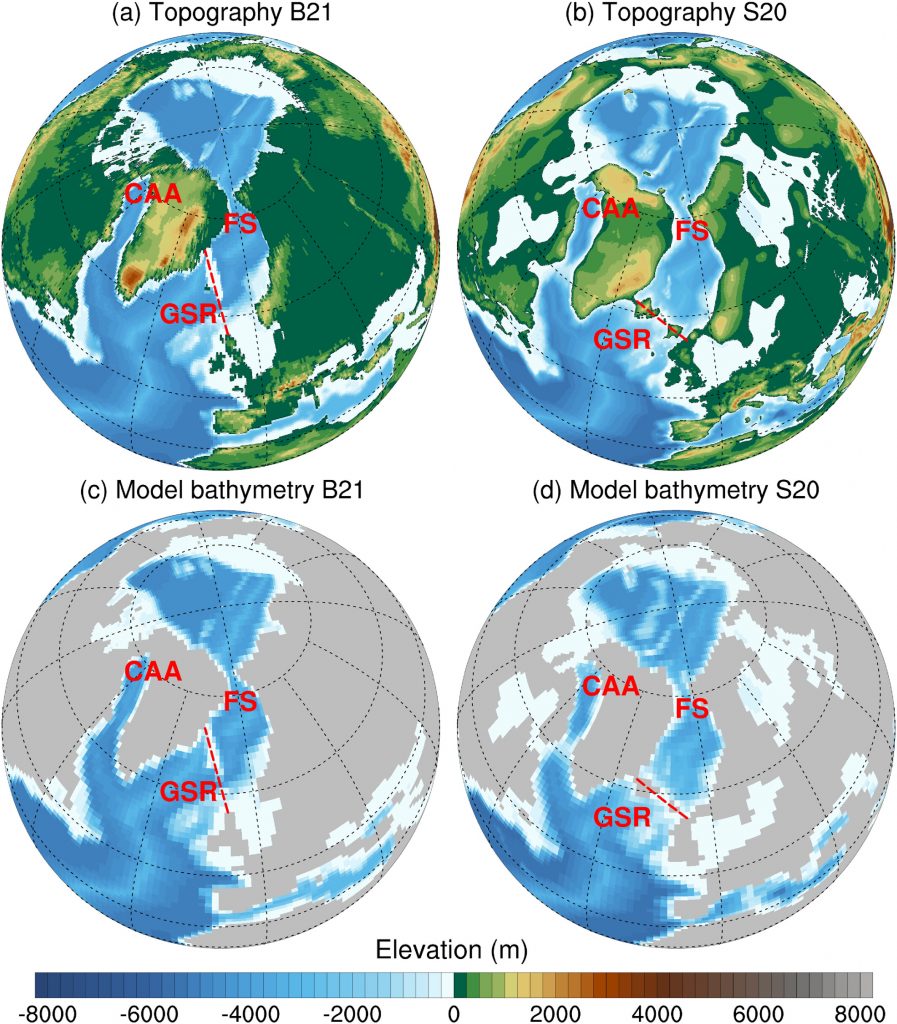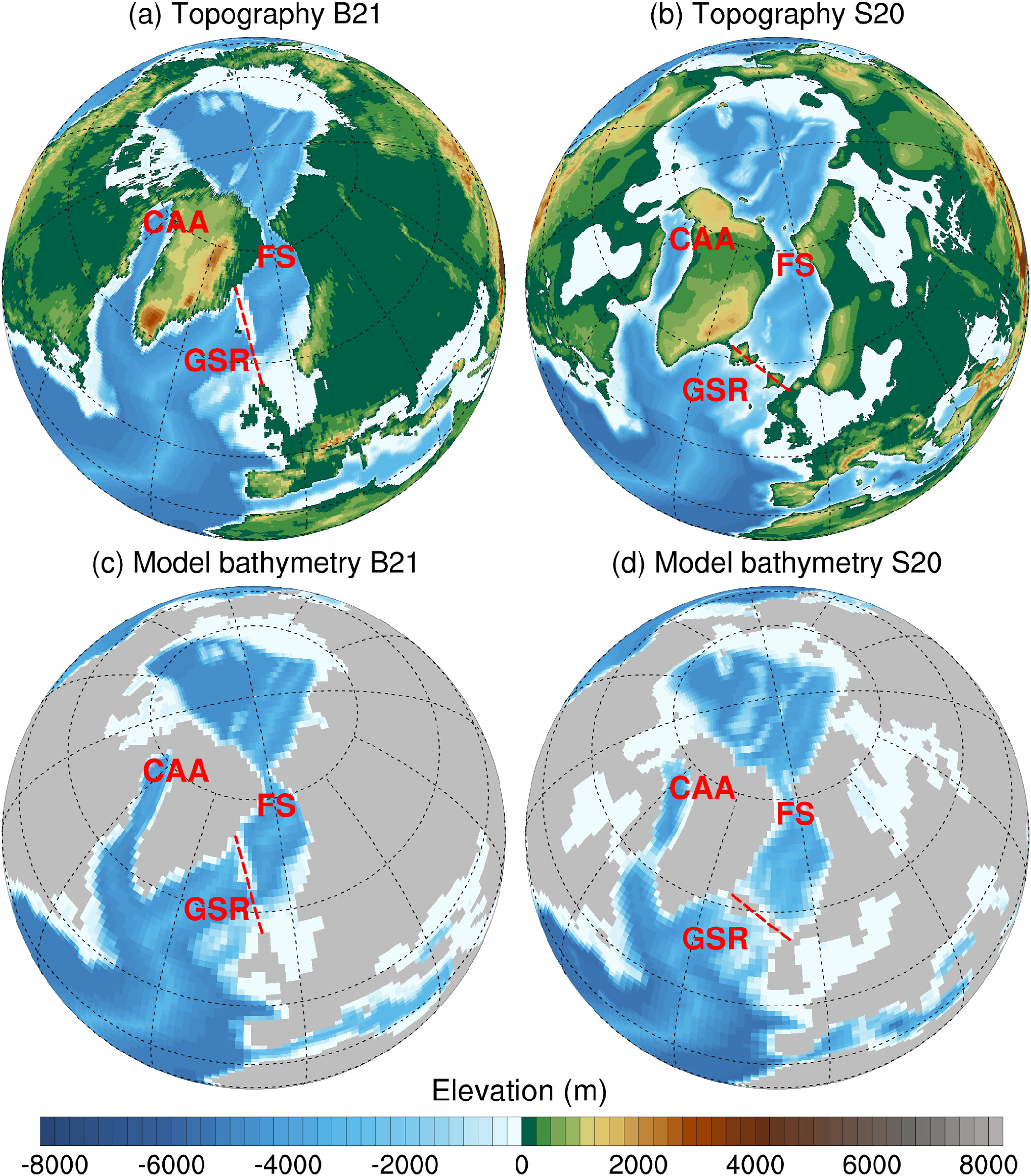
During the Cenozoic Era, the ocean’s meridional overturning circulation (MOC) has alternated between North Pacific and North Atlantic sinking modes. The Miocene Climatic Optimum (17.0–14.7 Ma) is a key interval for reconstructing this history because there is partial and inconclusive evidence for both MOC modes during this period. Here, we use the GFDL CM2.1 coupled climate model to investigate overturning circulation during the Miocene Climatic Optimum. Simulations are forced with atmospheric CO2 ${\text{CO}}_{2}$ levels of pre‐industrial concentration (286 ppm), double (572 ppm) and triple (858 ppm) CO2—the latter two falling within proxy‐based estimates for this period. We also test the impact of two different paleogeographic boundary conditions, with key differences in the Arctic–Atlantic gateways. Our results show that higher CO2 ${\text{CO}}_{2}$ levels favor North Pacific overturning (PMOC), while lower CO2 ${\text{CO}}_{2}$ favors North Atlantic overturning (AMOC), with outcomes also influenced by gateway geometry. These CO2 ${\text{CO}}_{2}$‐driven shifts are primarily due to hydrological feedbacks that freshen the Arctic in warmer climates. A paleogeography with a more prominent Greenland–Scotland Ridge supports AMOC, whereas an open Arctic–Atlantic connection suppresses AMOC and enables PMOC. Finally, we find evidence of bistability in the PMOC under triple CO2 forcing with a more prominent Greenland–Scotland Ridge: a PMOC “on‐state” emerges when the ocean is initialized with high North Pacific salinity, while an “off‐state” occurs with uniform initial salinity.