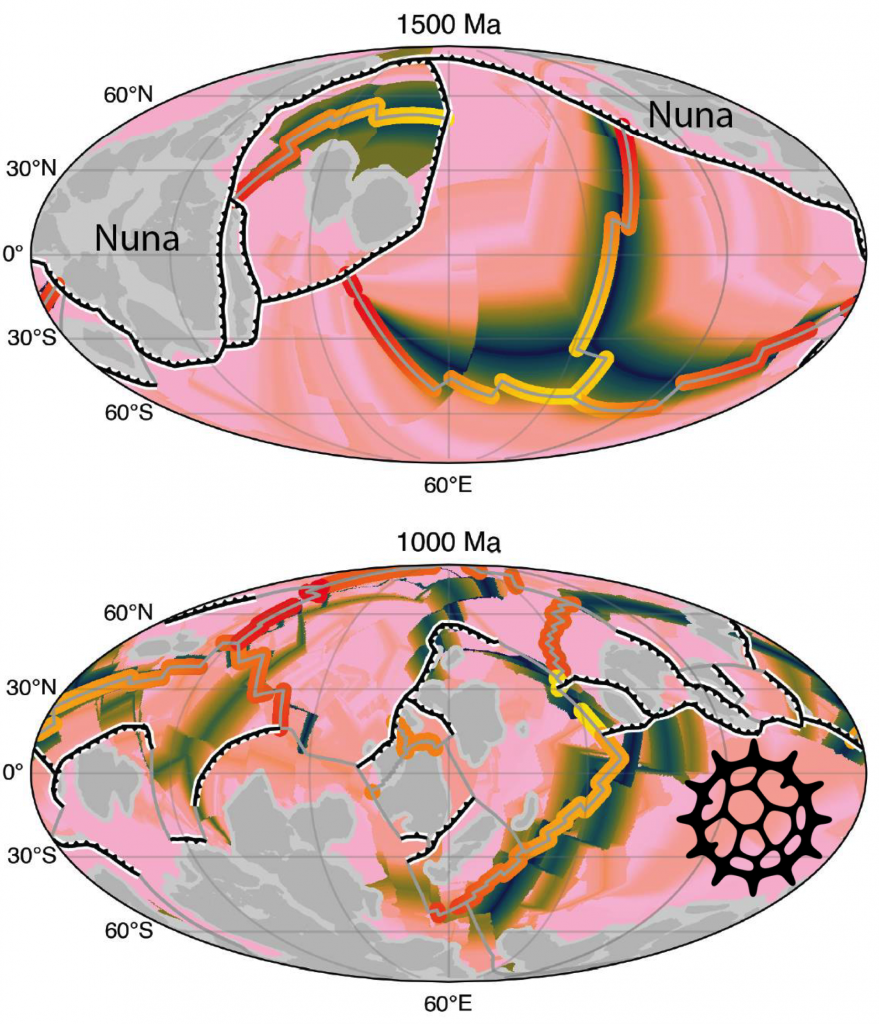
The mid-Proterozoic interval between 1800 and 800 Ma, commonly referred to as the “Boring Billion”, was marked by the emergence of eukaryotic cells from prokaryotic ancestors, a key step in the evolution of life. This period encompassed the assembly and dispersal of two consecutive supercontinents, Nuna and Rodinia, as well as the development of extensive ocean basins and partially oxygenated marginal seas, supporting early eukaryotic diversification under temperate conditions. However, the role that plate tectonic processes may have played in driving mid-Proterozoic ocean chemistry and global biochemical cycles has remained elusive and controversial. Here, we couple a recently developed plate tectonic model with dynamic boundaries covering the past 1.8 billion years (Ga) with a thermodynamic model to reconstruct the spatio-temporal evolution of active and passive margins, oceanic carbon reservoirs, and subduction-driven carbon recycling and outgassing. We show that the breakup of Nuna led to a two-fold increase in the global passive margin length over a period of ~350 Myr, peaking at ~130,000 km around 1.1 Ga. Post-Nuna continental dispersal was accompanied by numerous plate boundary reorganizations and a long-term shortening of subduction zones, which more than halved net solid Earth CO₂ outgassing. The long-term reduction in carbon outgassing and, by inference, associated global cooling, likely contributed to a reduction in oxidative weathering, promoting O2 buildup in the atmosphere. The contemporaneous mid-Proterozoic expansion of long-lived passive margins thus provided favorable oxygenated and temperate conditions for the diversification of aerobic eukaryotes in shallow marine environments.