
Magnetotellurics (MT) utilize measurements of electromagnetic fields at Earth’s surface
to image the electrical conductivity distribution at depths from a few meters to ∼200 km.
MT is especially powerful for mapping mineralized fluid pathways, as it is sensitive to inter-
connected minor conductive phases such as fluids, melts, or sulfides. However, conductivity
anomalies documented by lithosphere-scale MT surveys do not necessarily capture the ge-
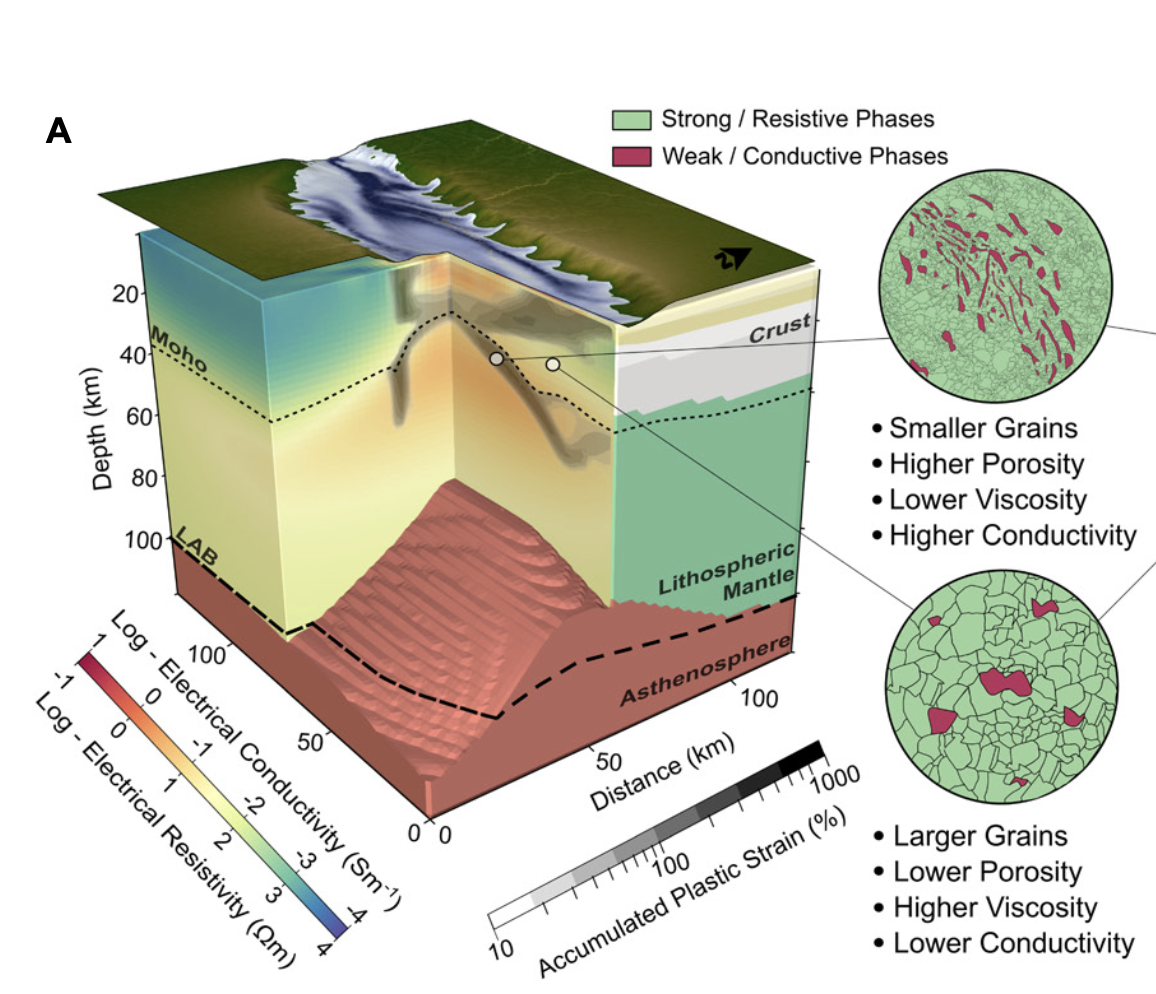
ometry of conductivity structures at depth and are often hard to interpret. To address this
limitation, we developed a new approach that integrates laboratory-based conductivity with
3-D thermomechanical modeling. Our aim was to test the relationship between strain and
conductivity in the case of a pull-apart basin. We show that networks of high-strain zones,
which largely govern fluid transfer across the lithosphere, exert a first-order control on spatial
distribution of conductivity anomalies. When compared to real MT data from the Marmara
pull-apart basin along the North Anatolian fault (northwestern Türkiye), our synthetic survey
shows good agreement with observed conductivity anomalies. This relationship suggests that
strain plays a key role in controlling electrical conductivity distribution in the lithosphere by
facilitating the interconnectivity of conductive phases.


