
Abstract. The global transition to clean energy is sharply increasing demand for rare earth elements (REEs), yet discovery rates are declining, especially in areas concealed by younger cover. Deep learning (DL) offers new opportunities for mineral prospectivity mapping (MPM), but its application is challenged by sparse labelled mineral occurrences, strong class imbalance, and limited model transparency. To address these issues, we present DEEP-SEAM, an explainable semi-supervised DL framework that integrates geological, geophysical, geochemical, remote sensing, and topographic datasets to predict REE prospectivity in the northern Curnamona Province, South Australia. The framework employs the Deviation Network (DevNet), a semi-supervised anomaly detection model that learns from a small number of known REE occurrences together with abundant unlabelled samples. DEEP-SEAM produces highly accurate predictions: the top 2% of the mapped area contains 86% of known REE deposits, and nearly all known occurrences fall within the highest-prospectivity zones. These areas show strong spatial association with felsic granites, major faults, and Mesoproterozoic metasedimentary sequences—features consistent with established REE mineral system models. To improve interpretability, we apply SHapley Additive exPlanations (SHAP), which highlight radiometric signatures, magnetic pseudo-gravity attributes, hydrothermal alteration indicators, and key geochemical principal components as the most influential predictors. These insights align with independent geological evidence, strengthening confidence in the predictive outcomes. DEEP-SEAM provides a transparent, scalable, and data-efficient approach for delineating REE prospectivity in complex and partially covered terranes, offering a valuable tool for reducing exploration risk and guiding future targeting efforts.
Luo, Z., Farahbakhsh, E., Hore, S., and Müller, R. D.: DEEP-SEAM: an explainable semi-supervised deep learning framework for mineral prospectivity mapping, Geosci. Model Dev., 19, 2593–2625, https://doi.org/10.5194/gmd-19-2593-2026, 2026.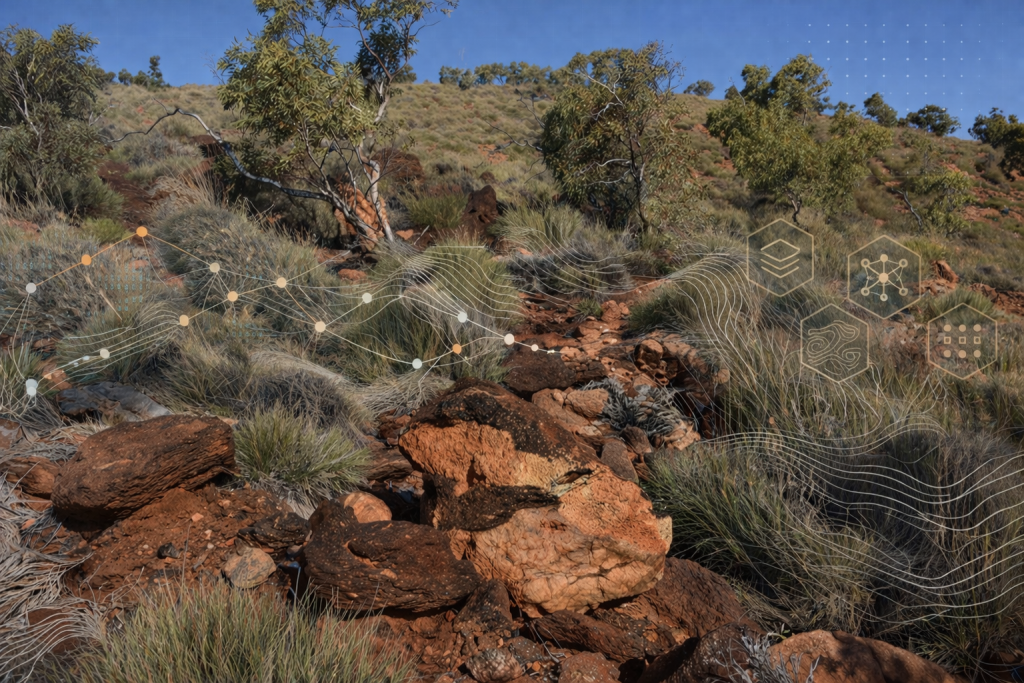 Monazite-bearing schist exposure southwest of the Paralana Plateau in the Mount Painter Inlier, northeastern Flinders Ranges. These metamorphic rocks host rare earth element mineralisation associated with hydrothermal alteration and structural pathways. Photo credit: Stephen Hore.

