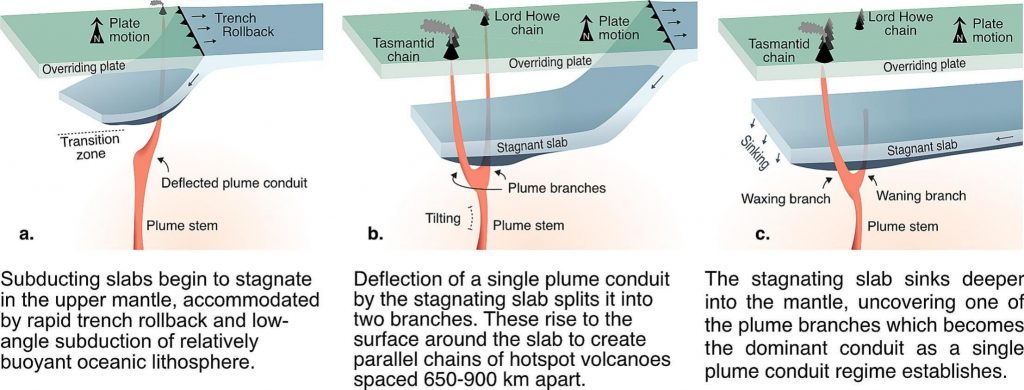
Using a 3D numerical model of mantle convection, the authors show how a single deep mantle plume can be split into two long-lived branches by a stagnating slab in the upper mantle, producing parallel volcanic chains. This explains why the Lord Howe and Tasmantid seamount chains in the SW Pacific have stayed 650–900 km apart for over 40 million years despite sharing a common deep-mantle geochemical signature. The model also predicts the Lord Howe chain is waning while the Tasmantid chain strengthens, foreshadowing their eventual merger into a single conduit.
Abstract. Deep mantle plumes are upwellings from the Earth’s core-mantle boundary to its surface, generating most hotspot chains. The Lord Howe and Tasmantid seamount chains in the SW Pacific have remained 650–900 km apart for more than 40 million years — closer than mantle plumes typically coexist without coalescing, yet too geochemically akin to be readily explained by two unrelated sources. Using a 3D numerical model of mantle convection, we show that a single deep plume can be split into two long-lived branches by a stagnating slab in the upper mantle, producing parallel volcanic chains that track plate motion for tens of millions of years before reconverging into a single conduit. Plate reconstructions of the SW Pacific reveal a geometry consistent with this mechanism: a ribbon of relatively young slab material subducted at the d’Entrecasteaux subduction zone sits between two windows of low slab density, through which the Tasmantid and Lord Howe branches rise around the obstructing slab. A shared EM1 isotopic signature in both chains confirms the plume is sourced from the lower mantle, ruling out alternative mechanisms which invoke upper mantle plume sources to explain dual hotspot chains and fail to reproduce the observed combination of spacing, persistence, and geochemical affinity. The model further predicts that the Lord Howe branch is presently waning while the Tasmantid branch strengthens, foreshadowing the eventual return to a single conduit. Plume branching driven by slab geometry may explain other closely spaced plume tracks, including two that have been linked to the Yellowstone hotspot.