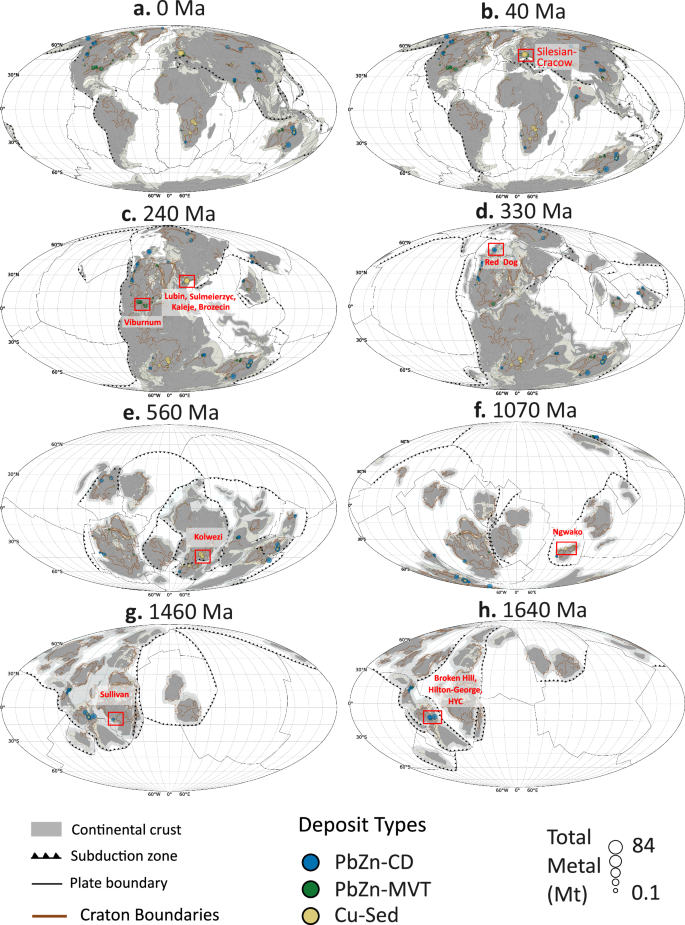
This study explores why sediment-hosted mineral deposits tend to form near the edges of ancient continental cores, or cratons. By combining a 1.8-billion-year plate motion model with seismic imaging of craton edges, geodynamic modelling and a global mineral deposit database, the authors show that mineralised craton edges typically formed 800-1800 km from active subduction zones, a pattern distinct from random craton locations. They propose that mantle flow generated by subduction weakens the lithosphere at these distances, promoting rifting and fluid infiltration that precondition the crust for ore formation, offering a new framework for predicting mineral resource distribution through deep time.
Abstract. Sediment-hosted mineral deposits cluster near craton edges, yet the geodynamic factors influencing this concentration remain poorly understood. To investigate the tectonic and geodynamic controls on craton-edge mineralisation, we integrate a 1.8 Ga global plate motion model with craton-edge mapping from full-waveform seismic tomography, geodynamic modelling, and a global mineral deposit database. Here we show that mineralised craton edges consistently cluster 800-1800 km from subduction zones at the time of formation, with some as far away as ~3000 km-a spatial pattern distinct from random craton-edge locations. Geodynamic models show that subduction generates broad mantle return-flow cells that focus lithospheric stress, strain, and weakening at comparable distances from the trench. We propose that this mechanically driven weakening promotes rifting, enhances permeability, and facilitates the infiltration of slab-derived volatiles, thereby preconditioning the lithosphere for metallogenesis. These results identify subduction-craton coupling as a first-order control on sediment-hosted mineral systems across multiple supercontinent cycles and provide a predictive geodynamic framework for understanding the distribution of continental resources through deep time.Subduction near cratons fosters conditions that enrich the mantle and promote mineral formation along craton edges.