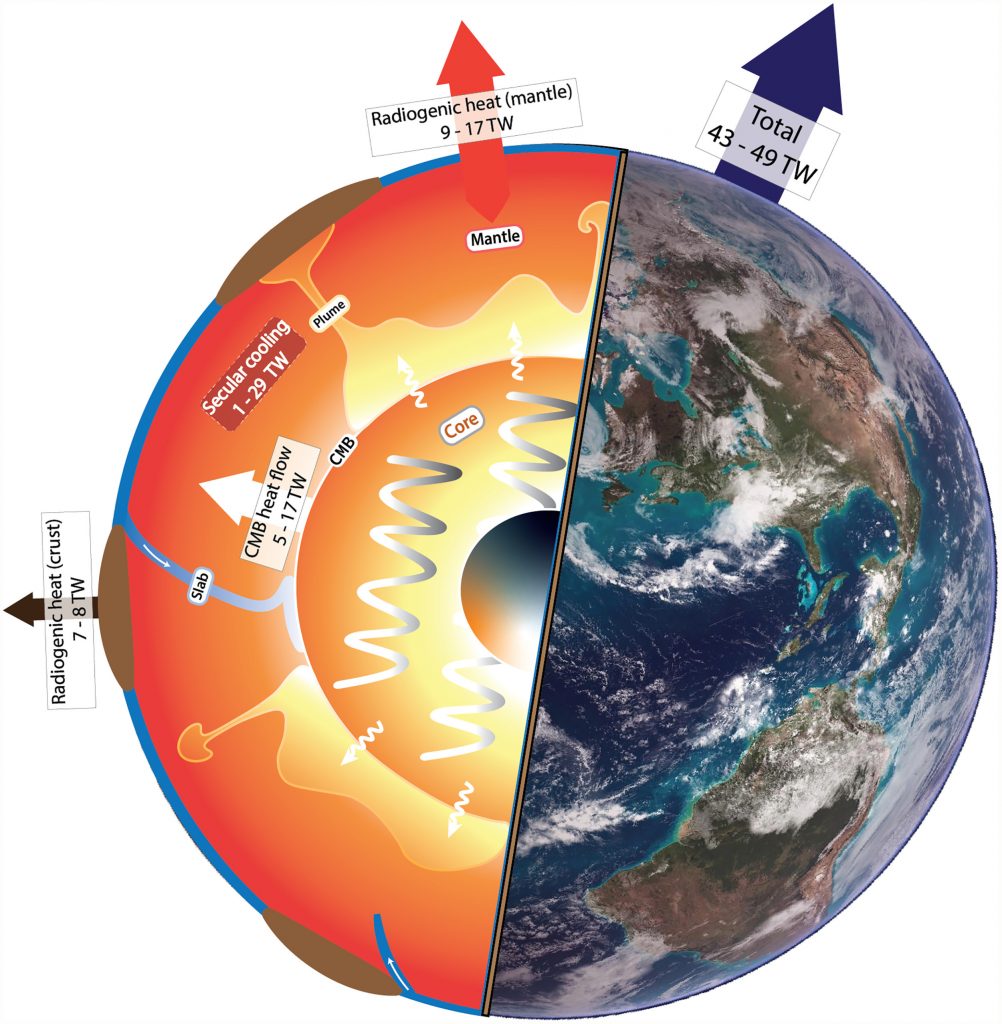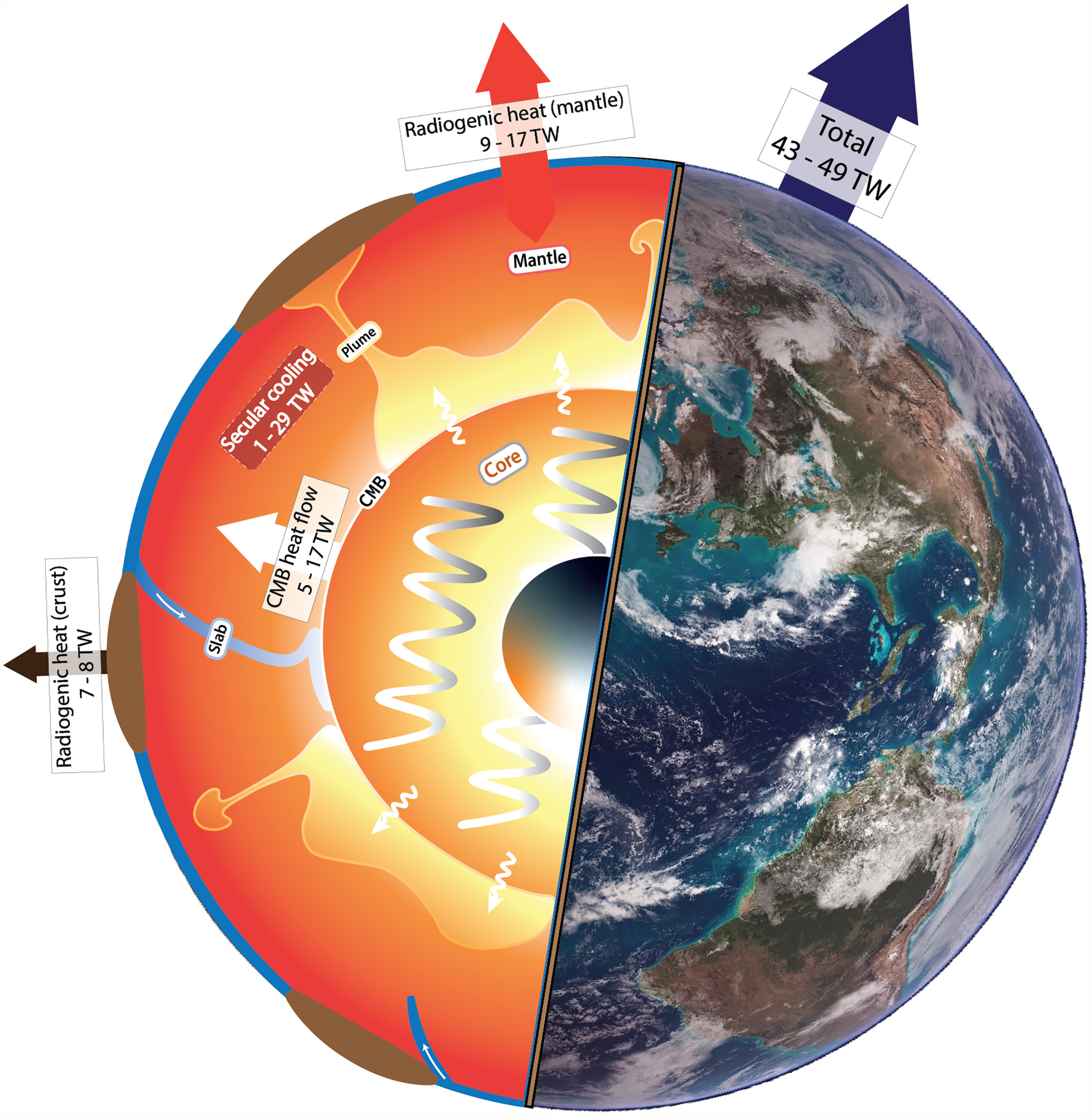
Researchers modelled global mantle flow over the past 1.8 billion years, incorporating the gradual cooling of Earth’s core and the decay of radiogenic heat sources through time. They found that this long-term cooling reduces both the heat flowing out of the core and the temperature of mantle plumes, at rates consistent with independent geological evidence. The results also show that sinking tectonic plates strongly influence deep mantle structure, and that cooling helps produce a present-day African deep mantle structure that better matches seismic images of the Earth’s interior.
Abstract. Petrological evidence and global heat budgets indicate that the solid Earth has cooled substantially over geological time, yet the influence of secular cooling on mantle dynamics in global 3D models remains poorly quantified. We incorporate secular cooling into 3D global mantle flow models using plate reconstructions extending back 1.8 billion years. The core-mantle boundary (CMB) temperature is modelled as decreasing over time in scenarios consistent with continuous outer-core dynamo action and inner-core crystallization, while the internal heating rate declines with radiogenic isotopes decay. We find that secular cooling reduces the magnitude of CMB heat flow and globally averaged mantle plume temperature. The predicted global plume cooling rate (∼110°C Gyr -1 ) is broadly consistent with petrological evidence for secular plume cooling. The predicted plume heat flow at ∼1,000 km depth (4–5.2 TW) is consistent with independent estimates from surface hotspots (2–4 TW), considering that lower-mantle plume heat flow is generally larger than upper-mantle plume heat flow. The CMB heat flux and the fractional area of Big LOwer-mantle Basal Structures (BLOBS) are strongly anti-correlated, reflecting that sinking slabs are central regulators of deep mantle heat transfer, with slab flux affecting deep mantle structure after a delay of 50–250 Myr. In the presented models, the evolution of the structure of the lower mantle is primarily controlled by the imposed plate reconstruction. However, secular cooling plays a second-order role as a decreasing plume flux and CMB heat flow result in a larger present-day African basal mantle structure that better matches tomographic models.