
Enhancing reproducibility in hybrid Earth system models
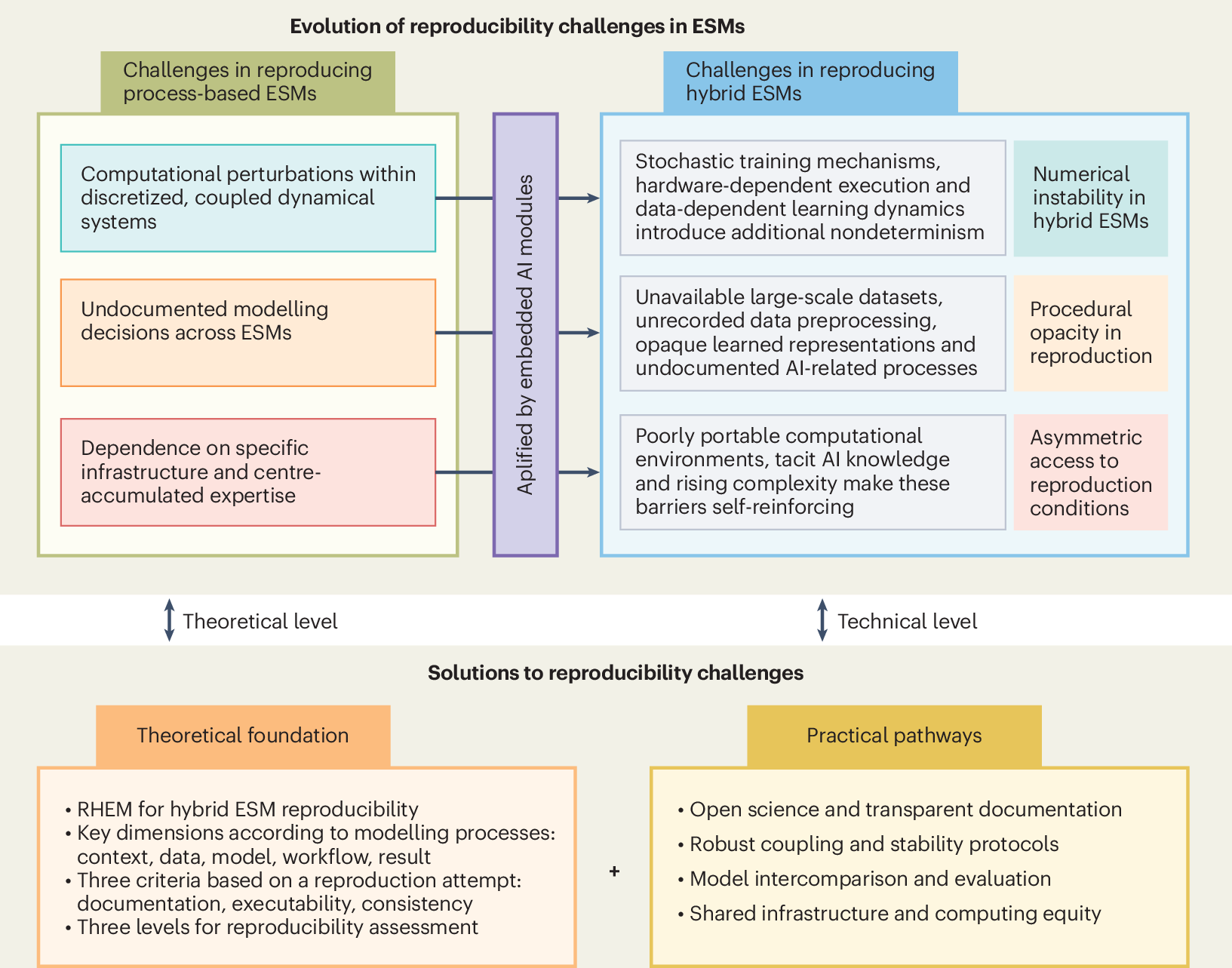
Diagram showing how reproducibility challenges in Earth system models have evolved from process-based frameworks to AI-integrated hybrid systems.

This Perspective argues that as artificial intelligence is increasingly built into Earth system models, reproducibility needs to be rethought to match how these hybrid models actually work. The authors highlight risks such as numerical instability, opaque procedures and unequal access to computing power, which can undermine trust and traceability in climate research. They propose a … Read more…

DEEP-SEAM: an explainable semi-supervised deep learning framework for mineral prospectivity mapping

Abstract. The global transition to clean energy is sharply increasing demand for rare earth elements (REEs), yet discovery rates are declining, especially in areas concealed by younger cover. Deep learning (DL) offers new opportunities for mineral prospectivity mapping (MPM), but its application is challenged by sparse labelled mineral occurrences, strong class imbalance, and limited model … Read more…

Applied Geochemistry: Multivariate statistical analysis and bespoke deviation network modeling for geochemical anomaly detection of rare earth elements

Rare earth elements (REEs), a significant subset of critical minerals, play an indispensable role in modern society and are regarded as “industrial vitamins,” making them crucial for global sustainability. Geochemical survey data proves highly effective in delineating metallic mineral prospects. Separating geochemical anomalies associated with specific types of mineralization from the background reflecting geological processes … Read more…