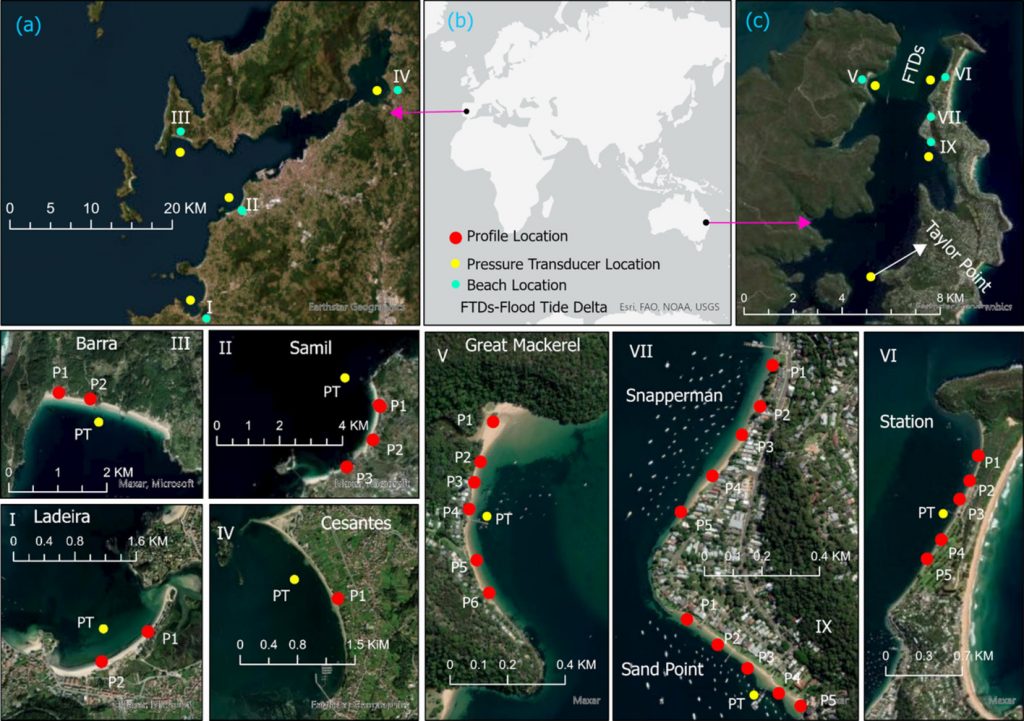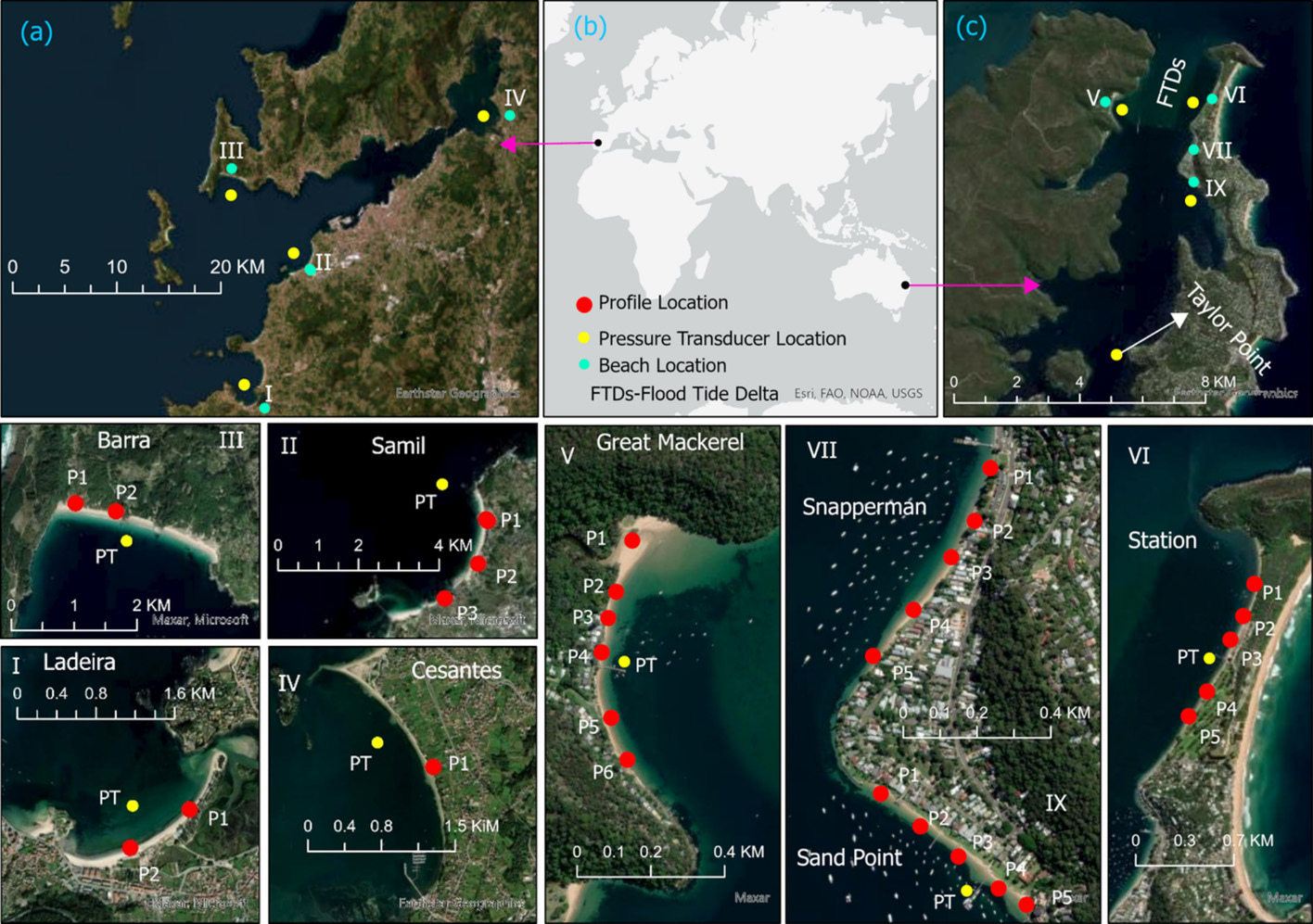
This study compares sandy beaches within estuaries and bays in a microtidal system (Pittwater, Sydney) and a mesotidal system (Ría de Vigo, Spain) to understand how waves, tides and sediment shape beach profiles. Swell waves dominate wave energy in both settings, but their relative contribution decreases further from the estuary entrance, where wind and infragravity waves become more important. Beaches exposed to more swell tend to have convex profiles and coarser, well-sorted sand, while sheltered beaches are concave with finer, poorly sorted sediment, highlighting how local wave exposure and tidal range control beach shape in estuaries worldwide.
Abstract. Sandy beaches in estuaries and bays (BEBs) are unique geomorphic features on the coasts of many of the world’s megacities. They exist under various settings and act as dynamic interfaces that influence hydrodynamics, sediment transport, and shoreline stability. Here, we investigate various beach profiles, wave conditions, tidal regimes, and sediment characteristics across two estuarine settings with different tidal ranges: the mesotidal Ría de Vigo (Galicia, Spain) and the microtidal Pittwater estuary (Sydney, Australia) to understand the morphodynamic process governing changes in BEBs profile shapes. Spectral wave analysis indicates that the differences in estuarine geomorphology, fetch, tidal range, and exposure to offshore swell waves collectively drive the BEB morphodynamics and changes in beach profile shape. Our findings indicate that swell waves provide the dominant energy input in both the microtidal (52%) and mesotidal (90%) estuaries, while the relative contributions of wind and infragravity waves vary depending on bathymetry, fetch length, and geomorphological configurations. Overall, BEBs within the same estuary exhibit distinct wave signatures depending on their location relative to the estuary entrance, tidal regime, and exposure to offshore wave energy. This study shows that BEBs with greater exposure to swell have Convex cross-shore profiles and typically coarser, well-sorted sediments. On the other hand, wave sheltered BEBs typically have Concave profile morphology, fine and poorly sorted sediments. The relationship between wave signatures and BEB profile morphotypes demonstrated in this study enhances our understanding of the morphodynamic processes shaping these complex systems. • Beaches in Estuaries and Bays (BEBs) near the entrance have higher swell energy. • Local wind and infragravity waves become more prominent in the inner BEBs. • Higher (lower) swell exposure drives convex (concave) profiles. • BEBs in higher tidal ranges show concave-convex profile regardless of swell energy. • Convex BEBs have coarser sediment, while concave ones develop with finer sediment.