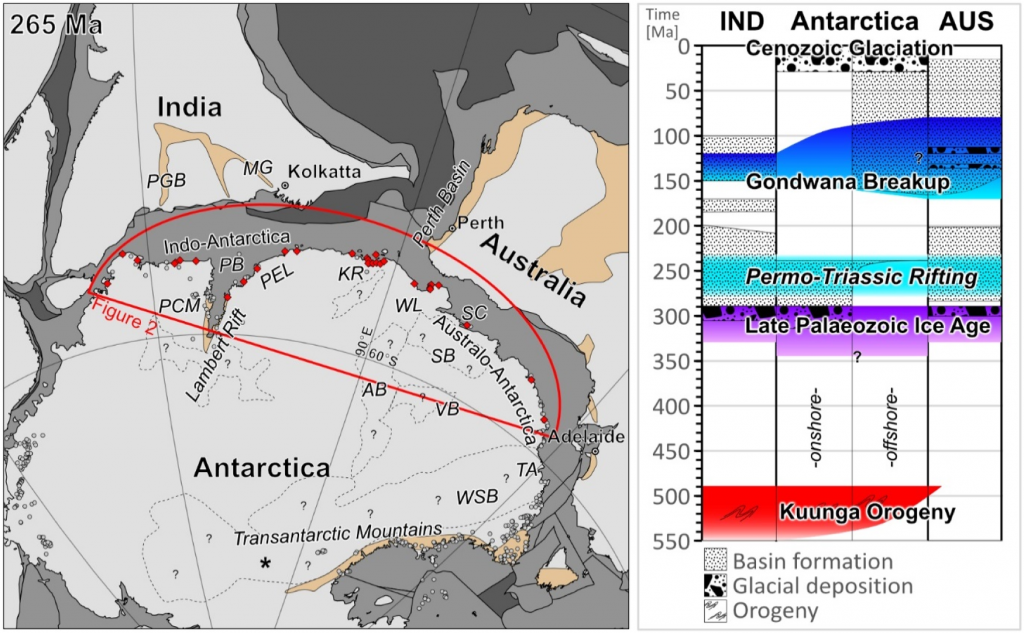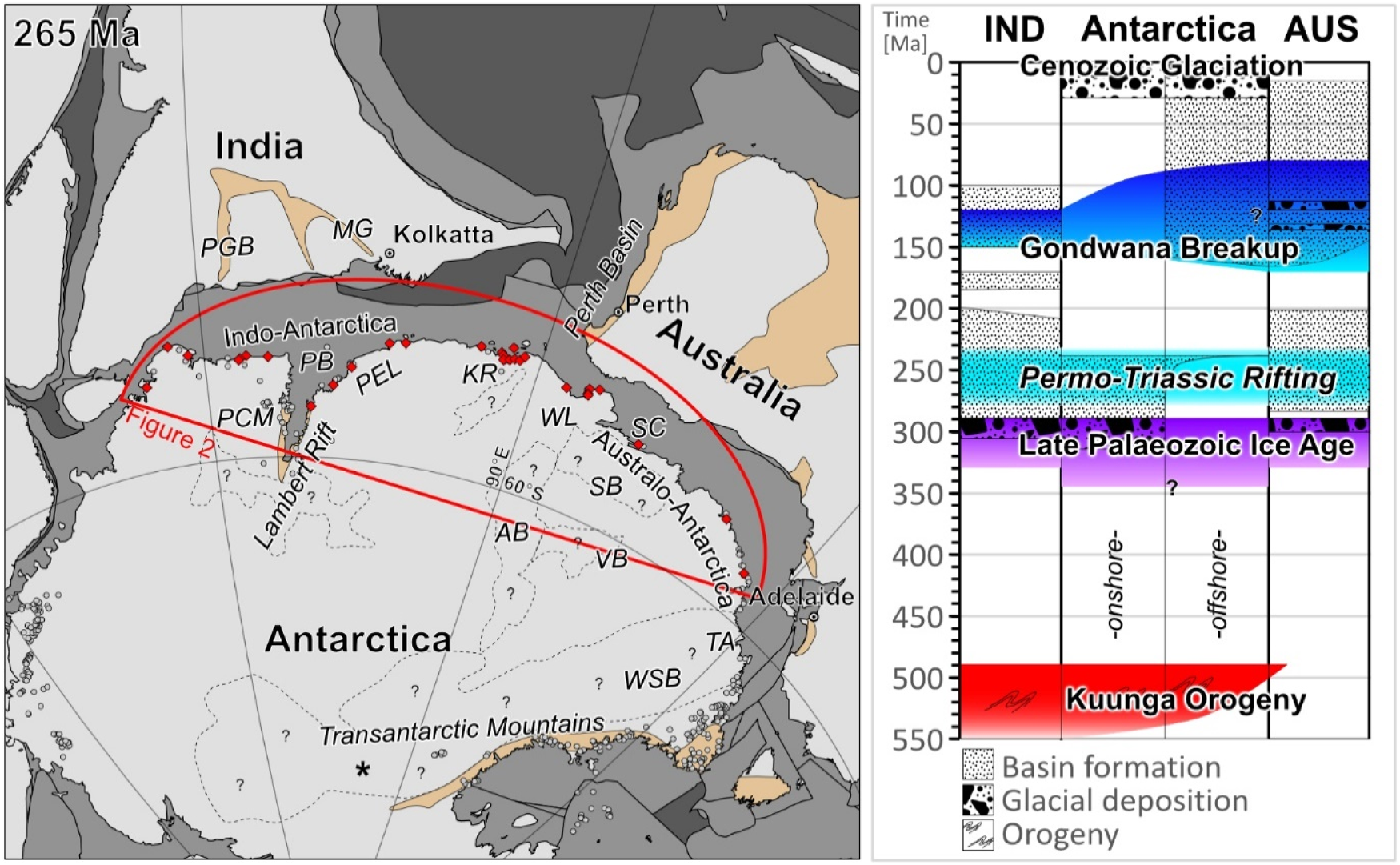
Researchers collected new apatite fission-track and (U-Th)/He data across more than 5000 km of the East Antarctic margin to reconstruct its rifting history. The results show that an earlier, failed rifting episode in the Permo-Triassic period cooled and shaped the crust more strongly than the later Jurassic-Cretaceous breakup of Gondwana itself. This multi-phase rifting appears to have been driven by external tectonic events elsewhere in Gondwana, such as the rifting of Cimmerian terranes and subduction along the Proto-Pacific margin.
Abstract. The East Antarctic margin (48°-150°E) holds key information on the breakup history of Pangea and Gondwa, yet thermochronological data is scarce compared to its conjugate rifted margins in India and Australia. Here we present apatite fission track and (U-Th)/He thermochronology, revealing a pervasive record of late Carboniferous and Permo-Triassic cooling for >5000 km of the East Antarctic margin, coincident with Pangea dispersal and predating Gondwana breakup in the Cretaceous. Inverse thermal history models indicate initial rifting of Gondwana likely started in the Permo-Triassic, leading to the formation of rift basins and cooling of basin margins along the incipient margin. This rifting episode then halted and was reinitiated in the Jurassic when further extension ultimately led to continental breakup, with the latter event resulting in less than 1 km of erosion in East Antarctica. Our results demonstrate that the failed Permo-Triassic rift phase had a greater effect on the present margin’s upper crustal thermal evolution than subsequent successful lithospheric rupture in the Jurassic and Cretaceous. While detailed interpretations are limited due to Antarctica’s extensive ice-cover, we suggest that external geodynamic forces such as the rifting of the Cimmerian terrane and the opening of the Meso-Tethys or subduction roll-back along the Proto-Pacific margin of Gondwana may have shifted the extensional locus away from the Antarctic margin and are likely drivers for this multi-phase rifting development.