
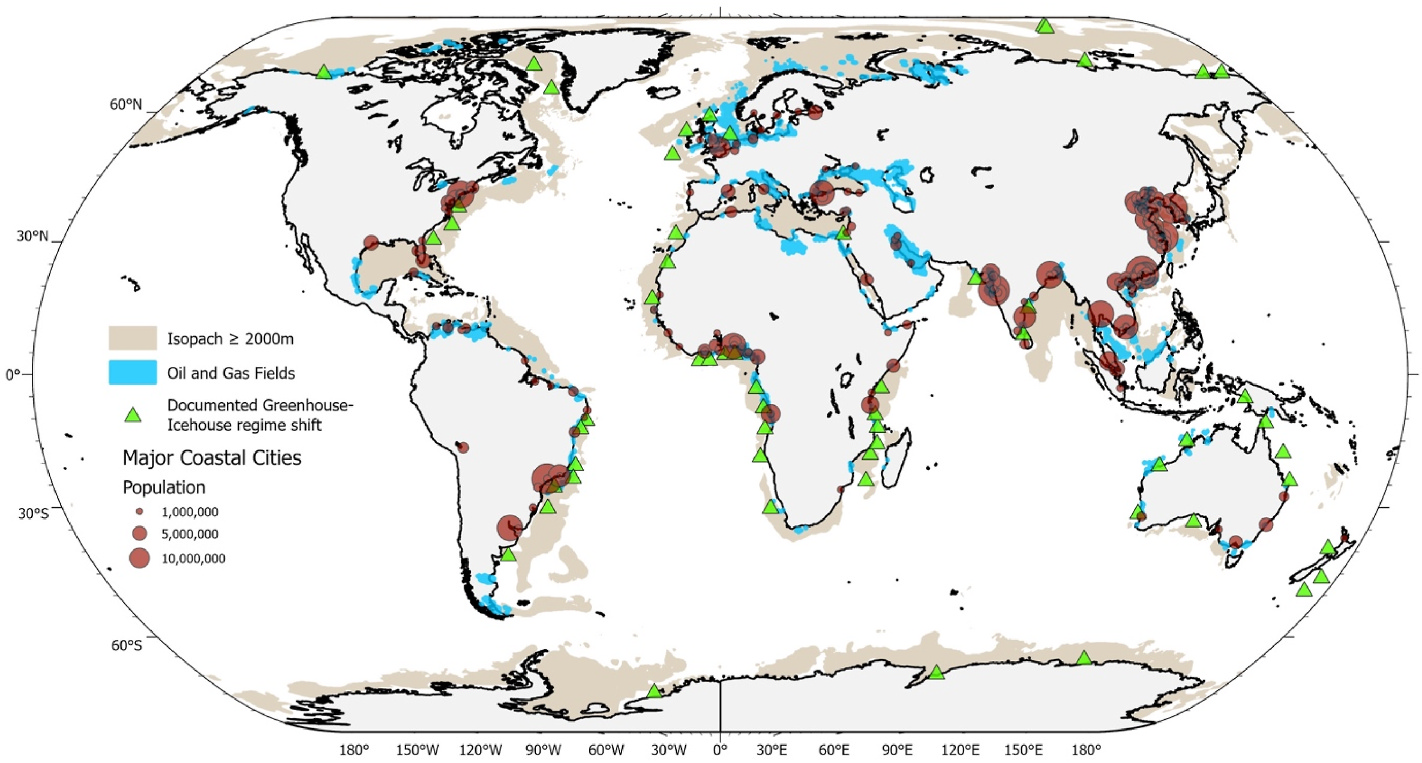
This study used forward stratigraphic modelling of the Hunter offshore margin in New South Wales to examine how Cenozoic sea-level changes shaped the layering of sediments on passive continental margins. The results show that warm 'greenhouse' periods produced thick, continuous sediment layers good for storing gases, while colder 'icehouse' periods produced thinner, stacked layers that could act as seals, with the transition occurring around 34 million years ago. This work suggests that past climate-driven sea-level patterns could help identify promising underground sites for hydrogen storage, even where subsurface data are limited.
Abstract. The global energy transition demands large-scale, long-duration storage, with underground hydrogen storage (UHS) in geological formations emerging as an important option. Passive continental margins host extensive Cenozoic successions that may represent significant UHS targets, yet predicting stratigraphic architecture in data-limited regions remains challenging. This study investigates whether the shift from low-frequency, low-amplitude to high-frequency, high-amplitude Cenozoic sea-level forcing systematically preconditioned passive-margin stratigraphy for UHS. Simulations of the Hunter offshore margin (NSW, Australia) reveal a fundamental contrast: greenhouse conditions promoted thicker (>25–50 m), laterally continuous, progradational packages with reservoir potential, whereas icehouse conditions generated vertically stacked, thinner (<25 m) units potentially suited for composite sealing systems, with the Eocene–Oligocene transition (∼34 Ma) separating these regimes. These findings suggest that sequential changes in sea-level forcing may have generated architectures favourable to reservoir and seal pairing and demonstrate that forward stratigraphic modelling provides a useful first-order screening approach where subsurface data are scarce.
Code and data: Zenodo: 10.5281/zenodo.20023698

