
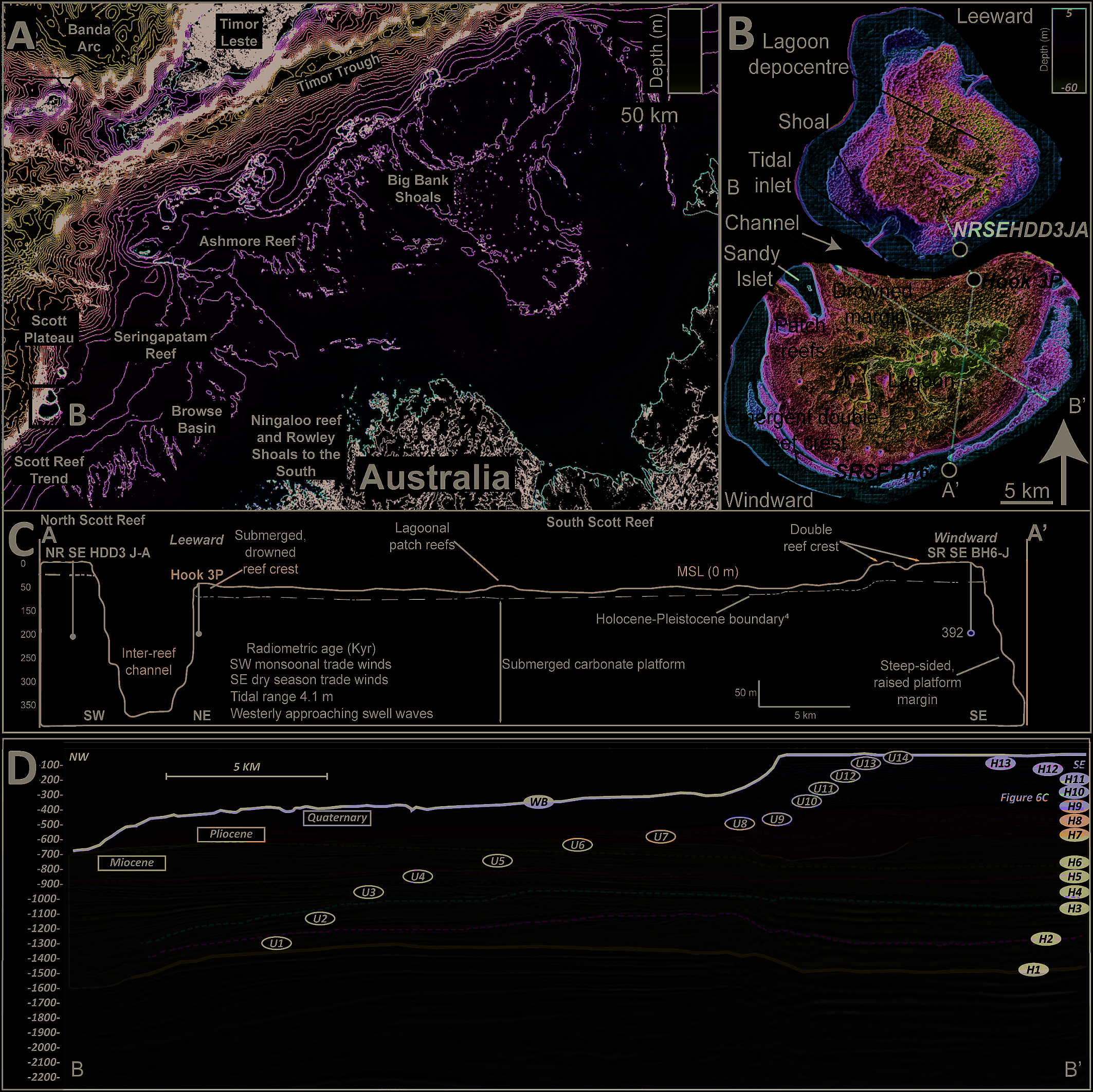
Researchers used forward stratigraphic modelling to reconstruct how Scott Reef, on Australia's Northwest Shelf, grew and changed shape during the Middle Pleistocene Transition, a period when ice age cycles became longer and more extreme. They found that a major sea-level fall around 1.2 million years ago exposed and karstified the reef, while a later long warm period allowed thick reef growth, with monsoon intensity and wave energy also shaping the platform's form. The study helps explain how carbonate reefs respond to major climate shifts, offering insights relevant to future reef change.
Abstract. This study presents the first forward stratigraphic model of Scott Reef – two isolated carbonate platforms on the Northwest Shelf (NWS) of Australia, spanning the Middle Pleistocene Transition (MPT; ca. 1.2–0.7 Ma). Scott Reef preserves a unique archive of reef growth sequences paced by millennial (10 3 -year) to orbital (10 4 –10 5 -year) scale sea-level variability under continuous high subsidence, providing valuable analogues for Quaternary reef dynamics and potential future reef responses to accelerated climatic change. We apply forward stratigraphic modelling (FSM) to reduce uncertainty in the existing chronostratigraphic models of Scott Reef, generate synthetic data to improve seismic interpretation, and to test how changing eustatic and environmental conditions during and after the MPT influenced carbonate production, facies distributions, and platform morphology. The model is calibrated using modern bathymetry, seismic sequence stratigraphy, sedimentary facies, coralgal assemblages, U/Th ages, and temporal changes in carbonate production and wave energy. The best fit simulations require increased carbonate production and wave energy after ca. 0.5 Ma, coupled with reduced carbonate production on the South Reef leeward margin. Model results indicate that the first high-amplitude lowstand of MIS 12 initiated prolonged subaerial exposure, karstification, and the development of a bucket-shaped platform morphology, coincident with increased monsoonal intensification after ca. 0.5 Ma. Subsequent reef expansion during the long-duration MIS 11 highstand produced an 80 m thick aggradational reef rim and is consistent with timings of reef growth elsewhere along the NWS, although there are differences to timing and style of reef response to the MPT globally. Synthetic stratigraphy indicates a transition from thin (10–30 m), low-relief progradational-aggradational sequences prior to 0.5 Ma, to thicker (20–50 m) aggradational sequences in the post-MPT 100-kyr world. Constant subsidence rates used in the model (0.29 mm/yr at South Scott Reef and 0.45 mm/yr at North Scott Reef) indicate that increasing sea-level amplitude and reduced periodicity associated with the MPT modulated sequence thickness, resulting in changes in platform morphology and facies patterns after ca. 0.5 Ma. Coupled with continuous high subsidence and increasing monsoonal intensity, these changes indicate that both environmental and eustatic processes were major controls on Scott Reef evolution. Our model has broader implications for understanding the MPT globally, including timing and stratigraphic expression of carbonate platform responses. Trial-and-error style FSM, when ground-truthed to multi-scale observational data, remains a powerful tool to test hypotheses about carbonate platform and coral reef response to rapid environmental changes. • Forward stratigraphic models reduce uncertainty in Scott Reef's Quaternary evolution • Reef response to the MPT initiates during the MIS 12 lowstand. • MIS 11 initiated reef expansion, consistent with MPT response regionally. • MPT monsoon intensification reduced carbonate production, drowned South Reef margin. • Models calibrated to empirical data and coralgal assemblages improve model accuracy.
Code and data: GitHub: Carra2023/Scott-Reef-GPM-Base

