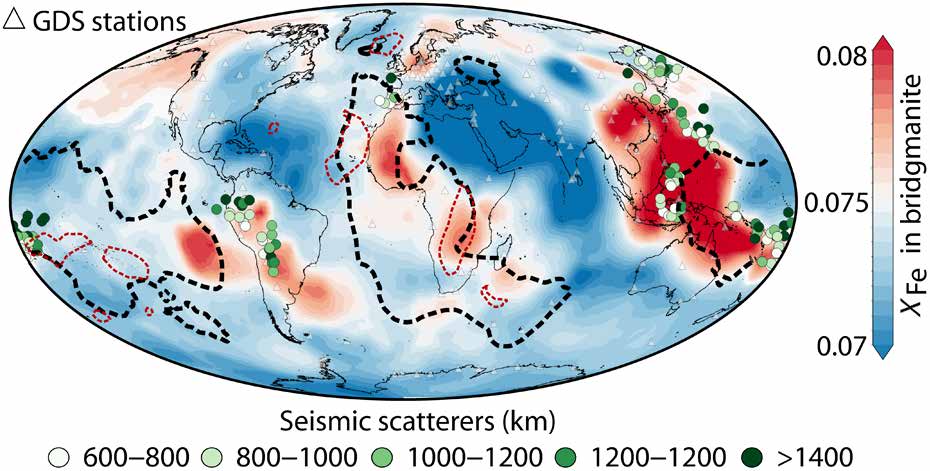
Scientists measured how well iron-bearing bridgmanite, the main mineral in Earth’s lower mantle, conducts electricity under high pressure and temperature conditions. They found conductivity rises sharply with iron content but barely changes with temperature, allowing iron variations to be mapped directly from global conductivity models derived from geomagnetic data. The results suggest iron-rich material within large low-shear-velocity provinces and an extensive deep reservoir of subducted oceanic crust beneath the western Pacific, offering new constraints on the mantle’s chemical composition and evolution.
Abstract. Iron distribution in Earth’s lower mantle profoundly influences planetary evolution by regulating mineral density and mantle dynamics but remains poorly constrained due to trade-offs between temperature and composition in seismic interpretations. Here, we resolve this challenge by measuring electrical conductivity of Al-, Fe-bearing bridgmanite, the dominant lower-mantle mineral, as a function of iron content ( X Fe ) under conditions reaching 2000 K and 27 GPa. Bridgmanite conductivity increases dramatically with X Fe following an X Fe 3.6 power law, while showing minimal temperature dependence. This pronounced sensitivity enables direct inference of global iron variation from geomagnetic-derived conductivity models. Our analysis reveals iron enrichment in large low–shear velocity provinces, supporting their thermochemical rather than purely thermal nature. We identify extensive high-iron regions beneath the western Pacific extending below 1000 km, indicating a vast basaltic reservoir of subducted oceanic crust. These findings provide independent constraints on Earth’s chemical composition and evolution.