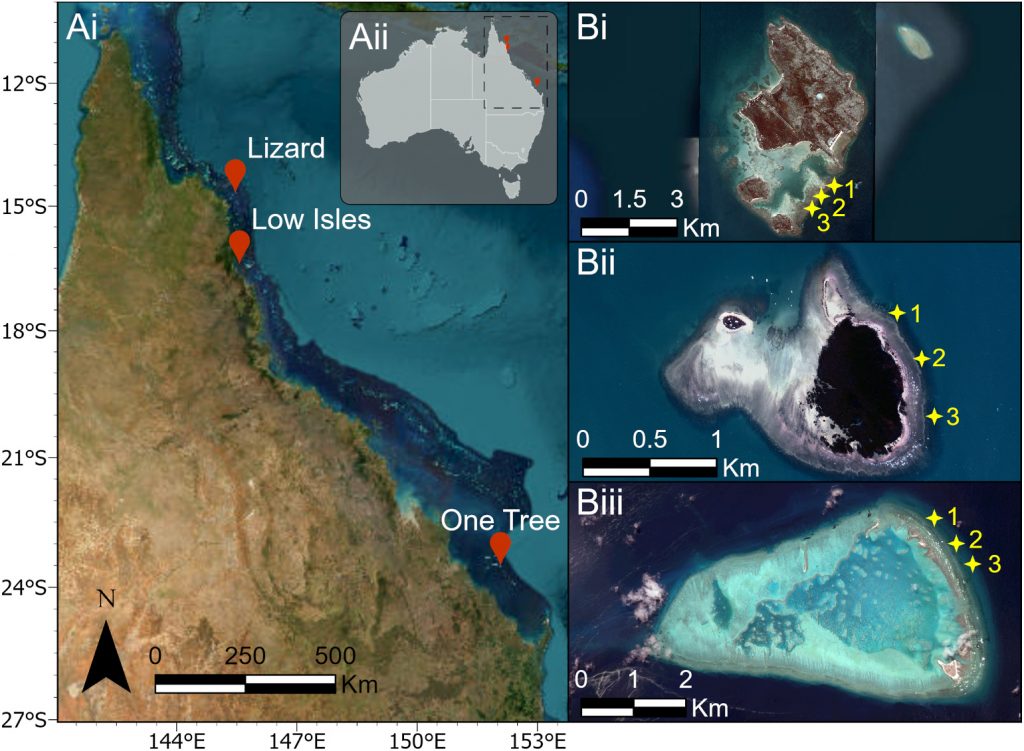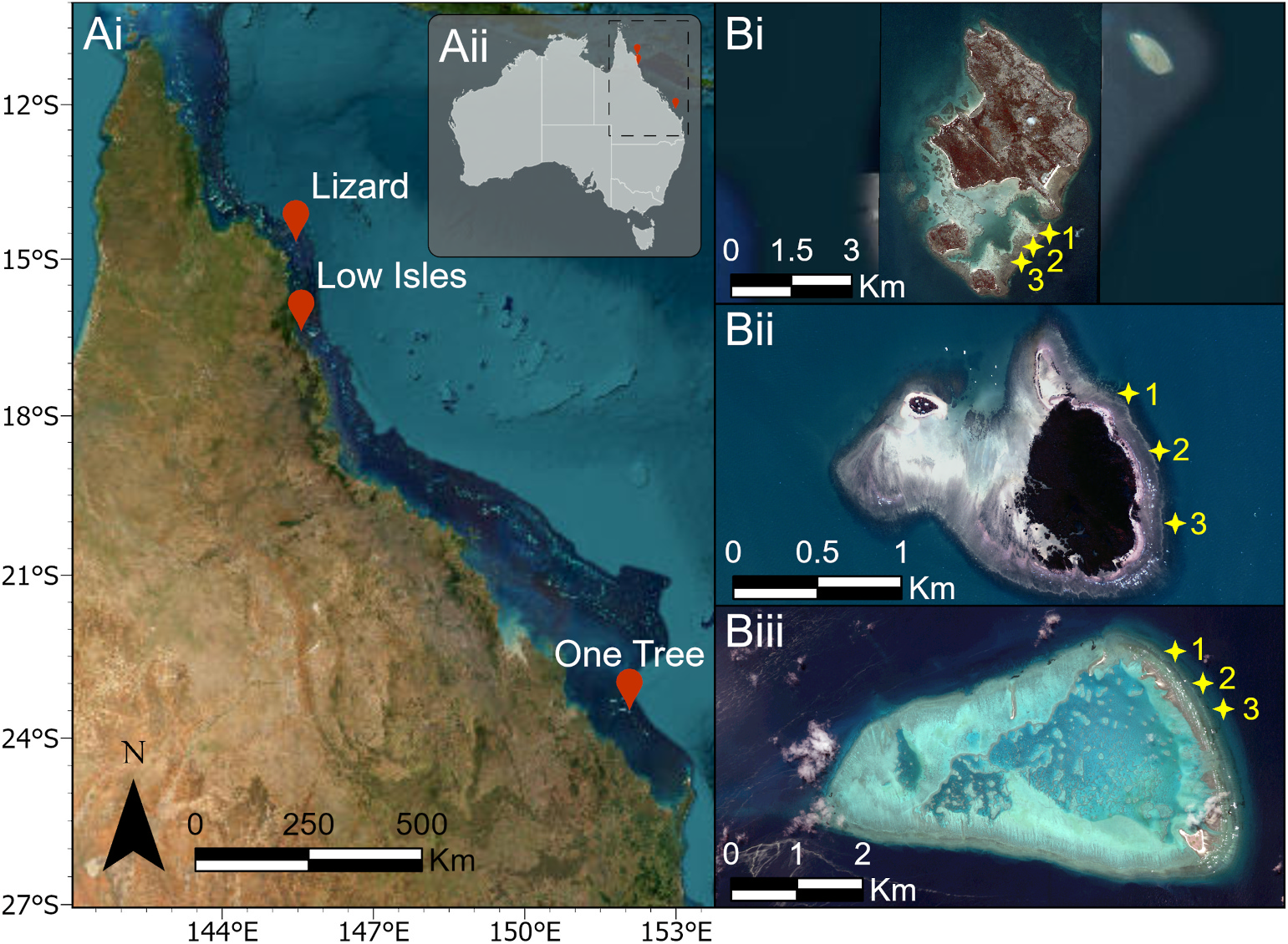
Coral reefs need enough living coral cover to support habitats, build carbonate structures and buffer waves, but it has been unclear exactly when reefs shift between healthy and degraded states, especially since different reefs have different baseline coral cover. This study tracked benthic cover from 1995 to 2022 at three Great Barrier Reef sites, indexing coral cover to each reef’s own historical maximum to make comparisons possible. The analysis identified three recurring reef states—healthy, coping and struggling—with coral loss below about 65% and 35% of historical maximums marking transitions, and showed that increasing disturbance drives reefs toward flatter, algae-dominated profiles regardless of their original coral makeup.
Abstract. Coral reefs rely on minimum thresholds of live hard coral cover to sustain key ecological and geomorphic functions, including habitat provisioning, carbonate production, and wave attenuation. While declining hard coral cover is widely recognised as a driver of reef degradation, the boundaries at which reefs transition between distinct functional states remain poorly defined-particularly across reefs with contrasting baseline conditions, where absolute cover values are not directly comparable. To address this gap, we quantified long-term changes in benthic composition from 1995 to 2022 across three eco-geomorphologically distinct reefs spanning the northern, central, and southern Great Barrier Reef. Hard coral cover was indexed relative to each reef’s historical maximum, allowing reef state transitions to be parameterised using comparable thresholds. Three reef states were identified, driven predominantly by shifts in coral cover and corresponding changes in algal dominance, with secondary reef-specific reorganisation in coral morphological composition shaped by baseline community structure. ‘Healthy’ states were characterised by high structural complexity; ‘coping’ states by overall hard coral cover decline, with reef-specific shifts in dominant coral morphology; and ‘struggling’ states by near-complete coral loss and algal dominance. Indexed hard coral cover provides a practical benchmark-with transitions into ‘coping’ states occurring below ∼65% of historical maxima, and further declines below ∼35% associated with ‘struggling’ states. Regardless of baseline morphological composition, disturbance-driven transitions toward flatter, algal-dominated reef profiles represent a convergent trajectory of functional decline-one that is likely to accelerate as disturbance regimes intensify under climate change.