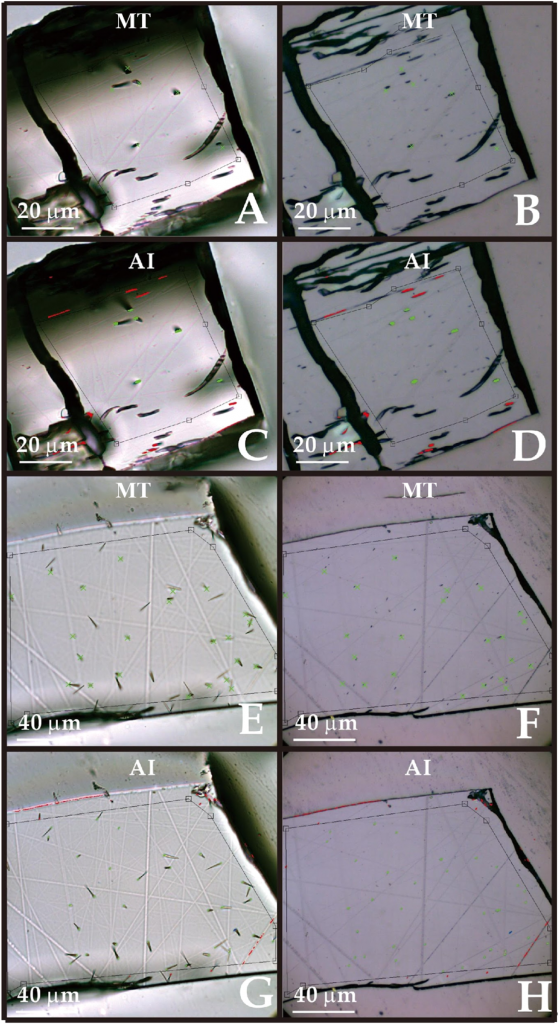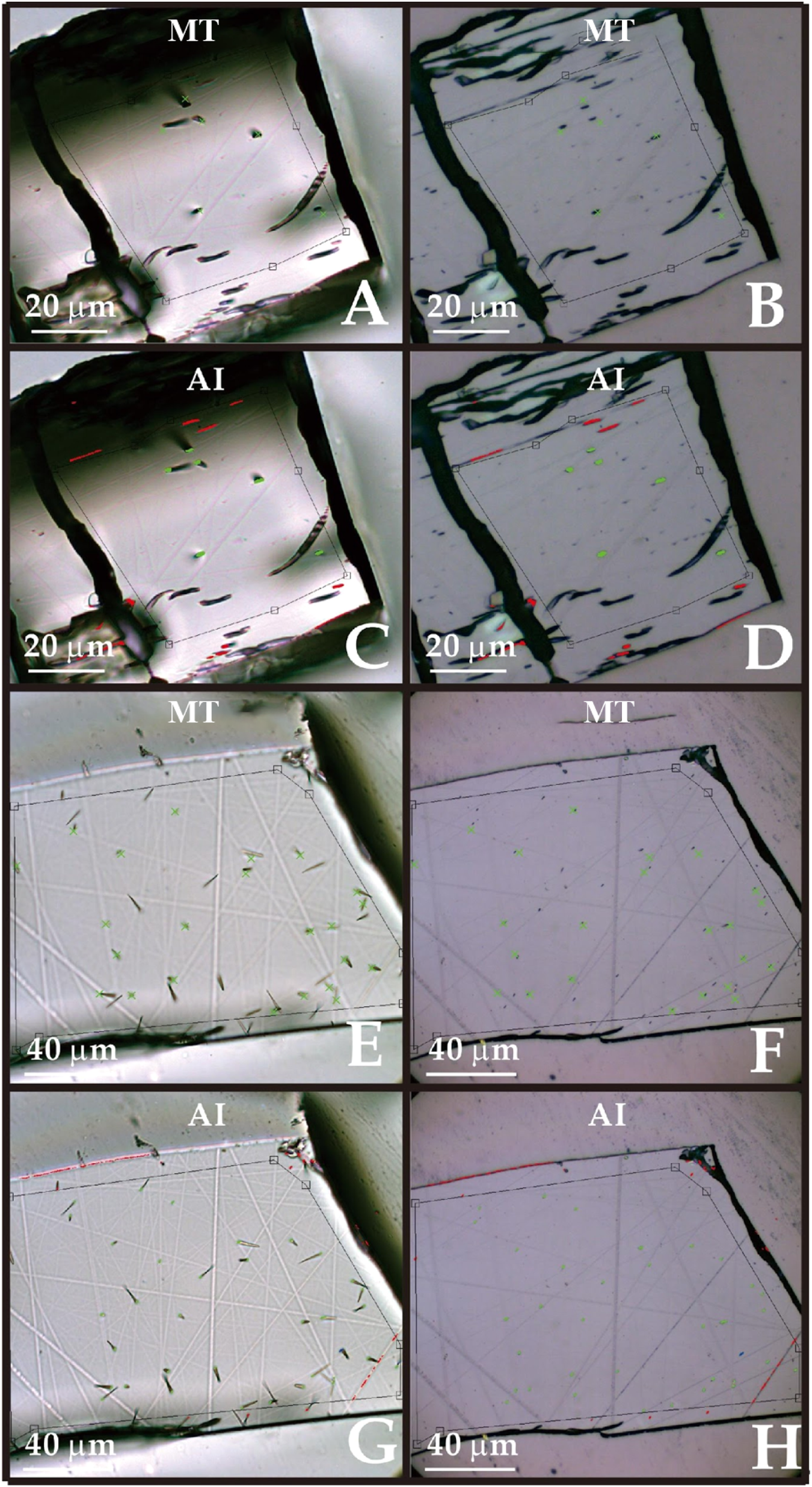
Researchers compared fission track counts made by a trained AI system (HALtracks 2D) with those of an expert human analyst using identical microscope images of apatite and mica samples. The AI matched human counts closely on clean, simple grains and performed comparably to the average expert even on more complex samples, though both struggled with noisy, low-quality grains. The study also found evidence that human counters become less consistent as track density increases, suggesting AI could help reduce variability between laboratories in fission track dating.
Abstract. We report the first image-based comparative study of human and AI fission track counts using apatite standards, real-world samples, and mica external detectors. A trained AI algorithm (HALtracks 2D, Boone et al., 2025) and an independent human analyst analyzed identical image datasets. On pristine grains, AI counts match human results within 96%. On complex samples, the AI deviates by ∼20% on average, but remains indistinguishable from the average expert analyst in the previous inter-laboratory study (Tamer et al., 2025). This study is bounded by the exclusion of highly problematic grains with a noise-to-signal ratio (N/S > 0.5), which the human analyst filtered out due to high subjective uncertainty. Consequently, even without manual review, HALtracks 2D performs as well as the average expert on standard and moderately complex datasets. Our results also provide the first quantitative evidence of decision fatigue in human counting. As track densities increase, cognitive load triggers more permissive identification criteria, whereas the AI maintains consistent performance regardless of complexity. Current AI remains prone to miscounting dislocations as tracks, but this work provides a blueprint for improving AI discrimination by detailing visual rejection criteria. Even now, adopting AI analysis would resolve much of the inter-laboratory irreproducibility that zeta calibration only partially corrects, replacing idiosyncratic bias with a shared criterion. Combining this removal of variable operator bias with robust non-track discrimination could deliver the “total annealing” of manual fission track analysis in the near future.