
Project Summary
Plate kinematic models derive from the detailed identifications of conjugate magnetic isochron picks and fracture zones (FZ). These data form the foundation of all relative marine plate tectonic reconstructions and codify our understanding of Earth’s surface evolution since the Mesozoic. Furthermore, FZ traces have extensive uses in many other marine geophysical investigations such as studying the origins of transform fault offsets, identifying seamounts and isolating abyssal hill roughness within fracture zone provinces, examining predictions from competing thermal models of the lithosphere, and much more. Kinematic models also require temporal information and this dimension is provided by identification of key magnetic isochron boundaries from total field magnetic anomalies collected along ship tracks. … Read more…
Prof Dietmar Müller
 Group Coordinator
Phone: +61 2 9351 4255
Fax: +61 2 9351 3644
School of Geosciences
The University of Sydney
Sydney, NSW 2006
Australia
View Dietmar's Sydney Uni page
See below for EarthByte content related to Dietmar.

Planet scale reorganisations of the plate-mantle system
Project Summary
Global climate change and shrinking resources have heightened our sense of dependence on the earth as a dynamic and complex system. This project aims to provide a unifying context for enhancing our understanding and appreciation of the workings of the inner earth and, in particular, its complex system behaviour during major tectonic events. … Read more…
Nature Geoscience – Origin of Indian Ocean Seamount Province by shallow recycling of continental lithosphere
Hoernle, K., Hauff, F., Werner, R., van den Bogaard, P., Gibbons, A. D., Conrad, S., & Müller, R. D. (2011). Origin of Indian Ocean Seamount Province by shallow recycling of continental lithosphere. Nature Geoscience, 4(12), 883-887. doi:10.1038/ngeo1331. Download the paper – link
Indian Ocean cocktail party leaves trail of party hats behind
Ana Gibbons, Dietmar Müller and colleagues from IfM-GEOMAR Leibniz Institute of Marine Sciences, Germany research into Indian Ocean Cocktail Party leaves trail of party hats behind has been highlighted on the USyd News page. See the USyd News article ‘Indian Ocean Cocktail Party leaves trail of party hats behind’ here
DICTA – A spatio-temporal knowledge-discovery platform for Earth-Science data
Landgrebe, T. C. W., & Muller, R. D. (2011, December). A Spatio-Temporal Knowledge-Discovery Platform for Earth-Science Data, Digital Image Computing Techniques and Applications (DICTA). In 2011 International Conference on (pp. 6-8). doi:10.1109/DICTA.2011.73. Download the paper – pdf
Lithosphere – Mantle dynamics of continent-wide Cenzoic subsidence and tilting of Australia
DiCaprio, L., Gurnis, M., Müller, R. D., & Tan, E. (2011). Mantle dynamics of continentwide Cenozoic subsidence and tilting of Australia. Lithosphere, 3(5), 311-316. doi: 10.1130/L140.1. Download the paper – pdf
Journal of Climate – Modelling the Miocene climatic optimum, Part 1: land and atmosphere
Herold, N., Huber, M., & Müller, R. D. (2011). Modeling the Miocene Climatic Optimum. Part I: Land and Atmosphere*. Journal of Climate, 24(24), 6353-6372. doi:10.1175/2011JCLI4035.1. Download the paper – pdf
EarthByte to attend GSA Fragile Earth conference 2011
EarthByte group members Dietmar Müller, Christian Heine, Nicolas Flament, Aedon Talsma, Logan Yeo and Grace Shephard are attending the GSA Fragile Earth conference in Munich, Germany from 4-7 September, 2011. Click here for details about the GSA conference
EarthByte members successfully seek STEPs funding
Simon Williams, Christian Heine, Leonardo Quevedo and Dietmar Müller were successful in a University of Sydney STEPs teaching enhancement program funding starting next year which will go towards the development of field-based geophysical data acquisition practicals for 3rd year students.
Michael Rubey commences his PhD with EarthByte
Michael Rubey begins his PhD with Prof Dietmar Müller and Dr Sascha Brune. The title of Michael’s PhD is ‘Plate Tectonic and Geodynamic Environments for Geological Resource Formation’.
Gondwana Research – Dynamic subsidence of Eastern Australia during the Cretaceous
Matthews, K. J., Hale, A. J., Gurnis, M., Müller, R. D., & DiCaprio, L. (2011). Dynamic subsidence of Eastern Australia during the Cretaceous. Gondwana Research, 19(2), 372-383. doi:10.1016/j.gr.2010.06.006. Download the paper – pdf
Nature – Plate motion and mantle plumes
Müller, R.D., (2011). Plate motion and mantle plumes, Nature. Download the paper – pdf
‘Towards a unified East Gondwanaland reconstruction and its implications for Himalayan Orogeny’ wins funding
EarthByte’s Dietmar Müller, Joanne Whittaker and Ana Gibbons along with Gordon Lister and Lloyd White of the Research School of Earth Sciences at ANU, Canberra, have won funding for their project “Towards a unified East Gondwanaland reconstruction and its implications for Himalayan Orogeny” from the Australia-India Strategic Research Fund (AISRF). This project will involve a close collaboration with Yatheesh Vadakkeyakath, K.A. Kamesh Raju, G.C. Bhattacharya and S. Kiranmai of the National Institute of Oceanography in Goa, India. The project follows on from a successful French-Australian collaboration that unraveled a new high-resolution plate model of the Australia-Antarctica-India plate boundaries, while similar information was obtained for the India-Antarctica-Africa plate boundaries under two recently concluded Indo-French collaborations. … Read more…
'Towards a unified East Gondwanaland reconstruction and its implications for Himalayan Orogeny' wins funding
EarthByte’s Dietmar Müller, Joanne Whittaker and Ana Gibbons along with Gordon Lister and Lloyd White of the Research School of Earth Sciences at ANU, Canberra, have won funding for their project “Towards a unified East Gondwanaland reconstruction and its implications for Himalayan Orogeny” from the Australia-India Strategic Research Fund (AISRF). This project will involve a close collaboration with Yatheesh Vadakkeyakath, K.A. Kamesh Raju, G.C. Bhattacharya and S. Kiranmai of the National Institute of Oceanography in Goa, India. The project follows on from a successful French-Australian collaboration that unraveled a new high-resolution plate model of the Australia-Antarctica-India plate boundaries, while similar information was obtained for the India-Antarctica-Africa plate boundaries under two recently concluded Indo-French collaborations. … Read more…
Cambridge University Press – Next-generation plate-tectonic reconstructions using GPlates
Boyden, J., Müller, R. D., Gurnis, M., Torsvik, T. H., Clark, J. A., Turner, M., … & Cannon, J. S. (2011). Next-generation plate-tectonic reconstructions using GPlates. Geoinformatics: Cyberinfrastructure for the Solid Earth Sciences. Keller, G. R., & Baru, C. (Eds.). (2011). Geoinformatics: cyberinfrastructure for the solid Earth sciences. Cambridge University Press. Download the paper – pdf
IODP workshop on Indian Ocean Drilling scheduled for late 2011
An Integrated Ocean Drilling (IODP) workshop on Indian Ocean Drilling to be held in late 2011 in Goa, India has just been approved, funded by $33,000 from IODP, and supported by the Australian IODP Office, which plans to send 15 Australians and Kiwis to the meeting, including EarthByte’s Dietmar Müller, and Stephen Gallagher (UMelb), Neville Exon (ANU), Richard Arculus (ANU), Mike Coffin (Tasmania) and Richard Wysoczanski (NZ, NIWA). The workshop is timed to suit an April 2012 drilling proposal submission deadline. … Read more…
EarthByte welcomes Logan Yeo
We welcome a new PhD student Logan Yeo who will be working with Dietmar and Christian!
EarthByte attends 2010 Theo Murphy High Flyers Think Tank
This month saw the release of the proceedings of the 2010 Theo Murphy High Flyers Think Tank, which was held at the Australian Academy of Sciences in August 2010 and brought together the nation’s top geoscience researchers, including EarthByte’s Prof. Dietmar Müller and Dr Thomas Landgrebe, to address challenges in mineral exploration. Dietmar and Thomas … Read more…
Full-fit, palinspastic reconstruction of the conjugate Australian-Antarctic margins
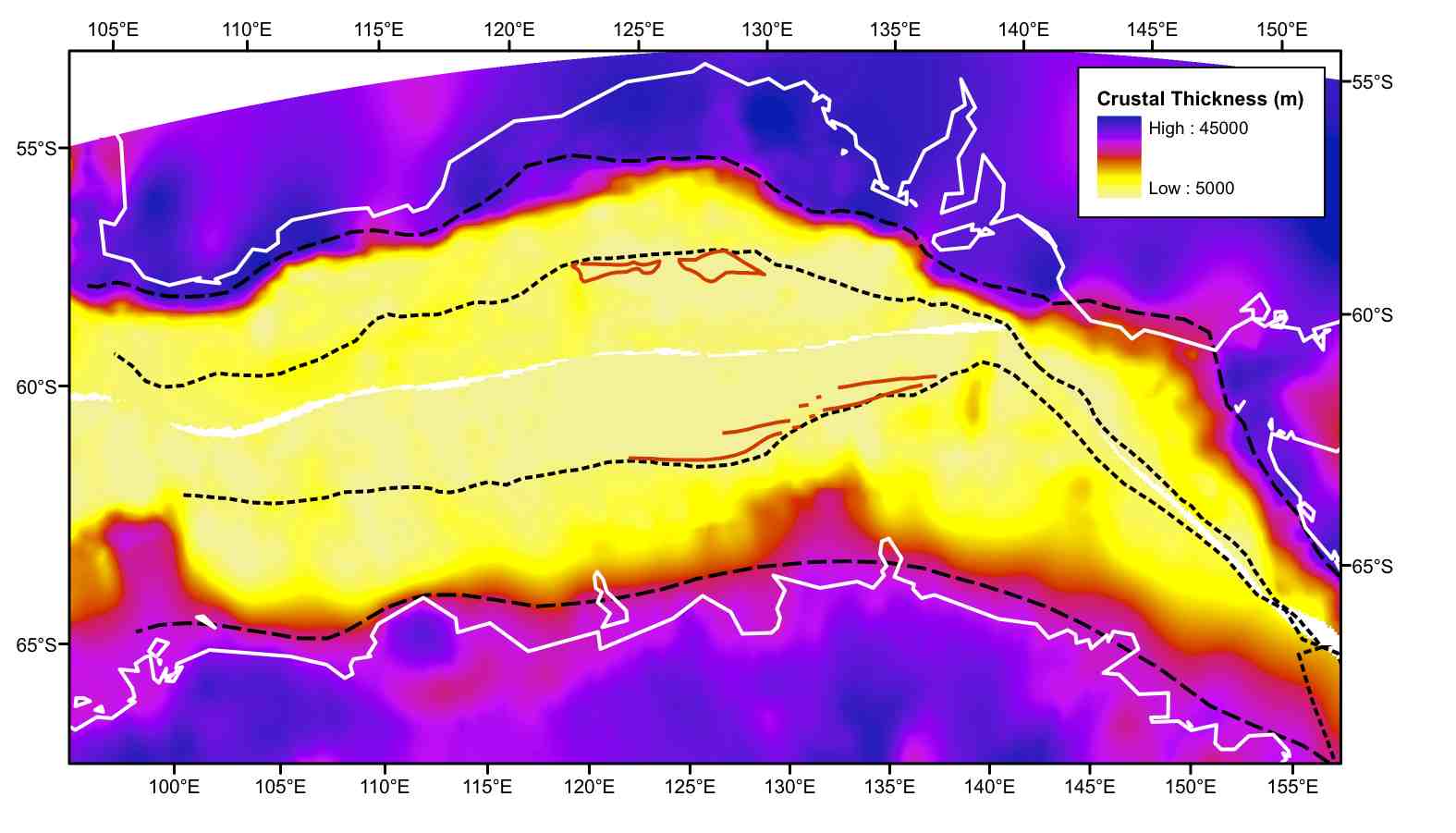 Despite decades of study the pre-rift configuration and early rifting history between Australia and Antarctica is not well established. The plate boundary system during the Cretaceous includes the evolving Kerguelen-Broken Ridge Large Igneous Province in the west as well as the conjugate passive and transform margin segments of the Australian and Antarctic continents. … Read more…
Dynamic subsidence of eastern Australia during the Cretaceous
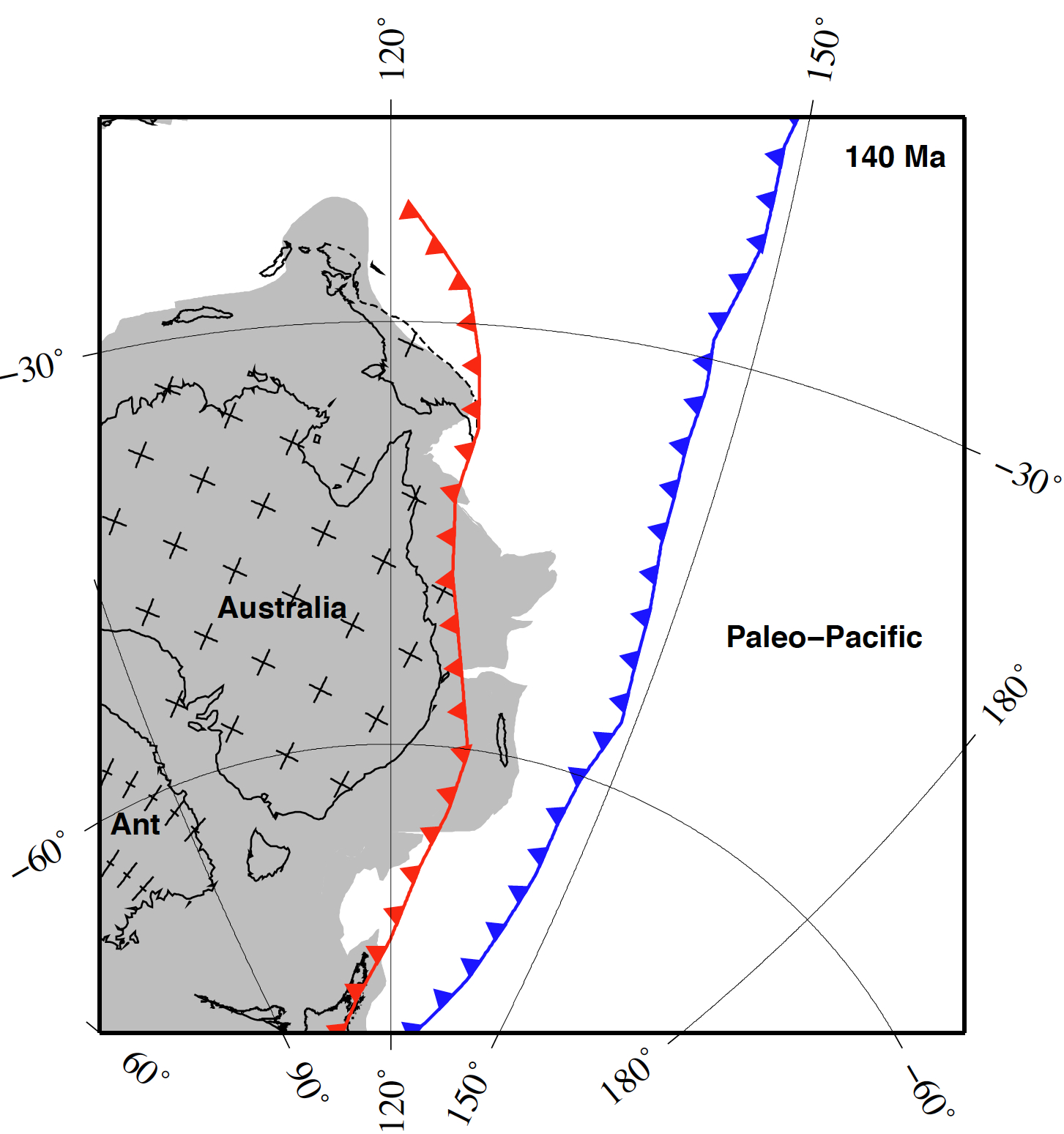 During the Early Cretaceous Australia’s eastward passage over sinking subducted slabs induced widespread dynamic subsidence and formation of a large eperiogenic sea in the eastern interior. Despite evidence for convergence between Australia and the paleo-Pacific, the subduction zone location has been poorly constrained. Using coupled plate tectonic-mantle convection models, we test two end-member scenarios, one with subduction directly east of Australia’s reconstructed continental margin, and a second with subduction translated ~1000 km east, implying the existence of a back-arc basin. Our models incorporate a rheological model for the mantle and lithosphere, plate motions since 140 Ma and evolving plate boundaries. While mantle rheology affects the magnitude of surface vertical motions, timing of uplift and subsidence depends on plate boundary geometries and kinematics. … Read more…
High resolution reconstruction of the Central and Eastern Indian Ocean
Project Summary
Plate reconstruction models for the rifting and separation of Gondwanaland’s conjugate margins continue to be poorly constrained. We propose to develop a new, high-resolution plate model for the central and eastern Indian ocean by synthesizing old and new geological and geophysical data utilizing combined French and Australian advanced software for magnetic anomaly modeling and plate tectonic reconstructions. We will test alternative continental fit reconstruction hypotheses by using a variety of reconstructed data sets. Such a joint research is timely, as the Indian Ocean continental margins become the focus of intense oil and gas exploration. … Read more…
Dietmar Müller awarded Mercator Professor Fellowship
Congratulations to Dietmar Müller who was awarded the Forschungsgemeinschaft (German Research Foundation) Mercator Professor Fellowship at the Ludwig-Maximilians-Universität München, Germany).
The subduction reference framework: Unravelling the causes of long-term sea-level change
Project Summary
Sea level has fluctuated by up to 300 m through geological time, creating vast sedimentary basins and associated natural resources. We will use Earth’s subduction history as imaged by seismic tomography to establish a subduction reference framework for the past 200 million years, tracking all tectonic plates in both latitude and longitude. 4D numerical mantle-plate tectonic simulations (3D plus time) will reconstruct how the recycling of old, cold oceanic plates into the mantle have influenced surface topography and sea-level change since the breakup of the supercontinent Pangaea. … Read more…
Integration of plate kinematic reconstructions in geodynamic models of mantle convection
Project Summary
Despite more than 30 years of plate tectonics research, we still do not know exactly what drives the plates or controls the time-dependence of mantle convection. Plate motions are linked to processes in the deeper Earth interior by complex, enigmatic cause-and-effect relationships. While mantle convection is generally accepted as the underlying cause of plate motions, the geometry of mantle flow and its relation to plate motions remains poorly understood. As plate tectonics is the Earth Science paradigm, breakthroughs in this field affect understanding of all branches of Earth Science including formation and distribution of natural resources, long-term climate change and natural hazards. … Read more…
Dietmar Müller awarded Australian Laureate Fellow
Congratulations to Prof. Dietmar Müller who has been awarded one of only 15 Australian Laureate Fellowships.
How supercontinents and superoceans affect seafloor roughness
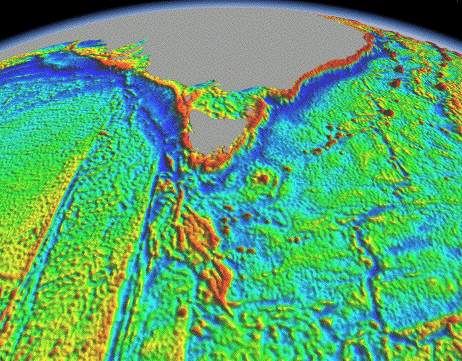
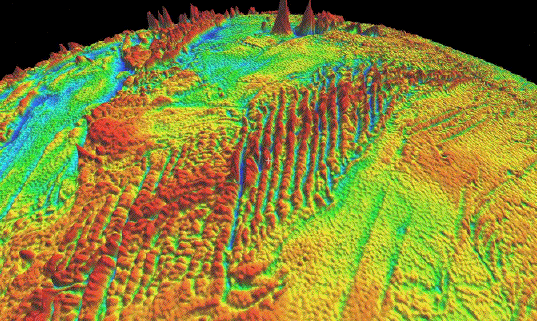
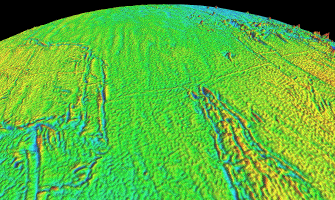
Seafloor roughness varies considerably across the world’s ocean basins and is fundamental to controlling the circulation and mixing of heat in the ocean and dissipating eddy kinetic energy. Models derived from analyses of active mid-ocean ridges suggest that ocean floor roughness depends on seafloor spreading rates, with rougher basement forming below a half-spreading rate threshold of 30-35 mm/yr, as well as on the local interaction of mid-ocean ridges with mantle plumes or cold-spots.
… Read more…
Age and Bathymetry of the World’s Ocean Crust for the last 140 million years
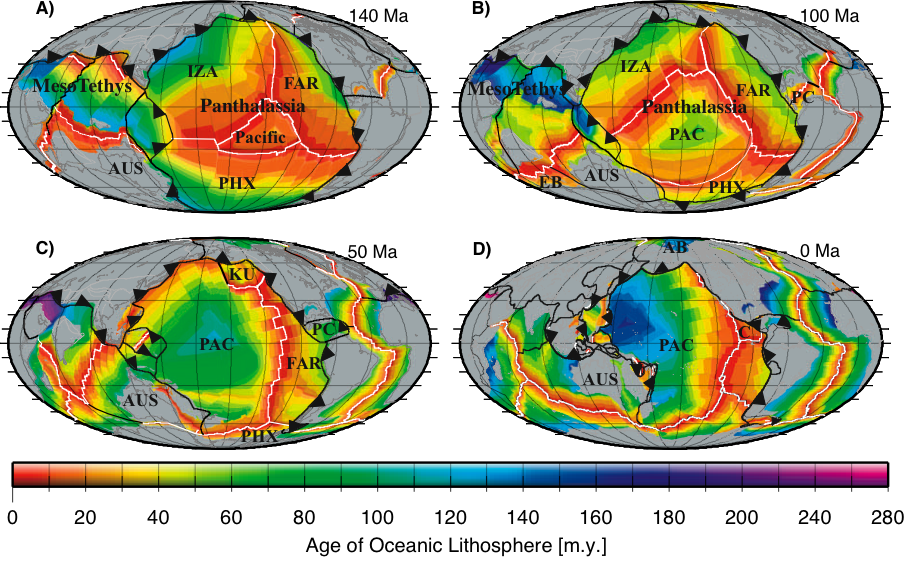 Reconstructing vanished oceans
We establish the locations and geometry of mid ocean ridges through time on the basis of marine magnetic anomaly identifications, geological information such as paleomagnetic data from terranes and microcontinents, especially in the Tethys Ocean, mid-oceanic ridge subduction events and the rules of plate tectonics. Based on a global set of tectonic plate rotations we construct a set of refined seafloor isochrons following the interpolation technique outlined by Müller et al. (1997; 2008) but including a multitude of additional data. … Read more…
Dietmar Müller awarded top reviewer in 2008
Congratulations to Dietmar Müller for being awarded top reviewer in 2008 for exceptional contribution to the quality of Tectonophysicsî by Elsevier, Amsterdam (The Netherlands), Publisher of Tectonophysics. Well done Dietmar!
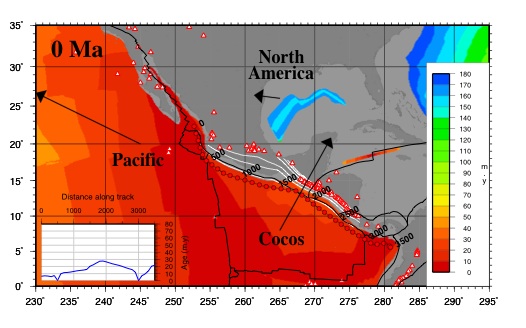
Global subduction and back-arc basin grids and data
Please Note: These age grids are now outdated. Please see the agegrids available from the Müller et al. 2013 study on Ocean Chemistry at the Seawater chemistry driven by supercontinent assembly, break-up and dispersal resource page.
 Downloads
Download global subduction age grid images via FTP here – tgz file
Download global subduction parameter dataset via FTP here – tgz file
… Read more…
Underworld
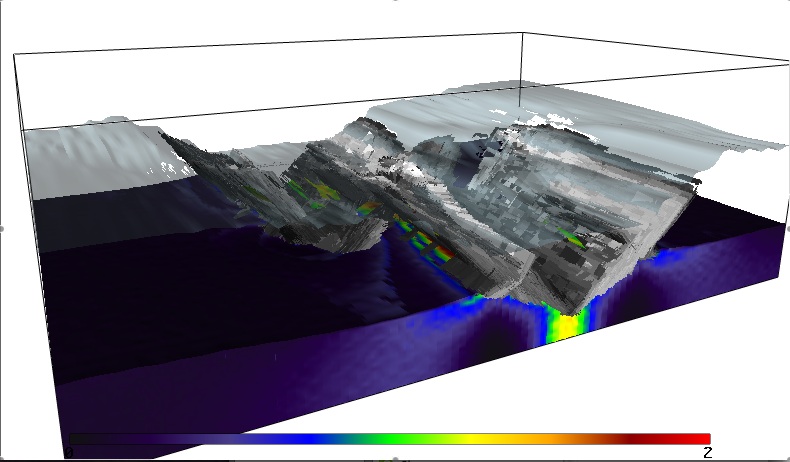 Underworld is a StGermain parallel modelling framework Geoscience research code, which utilises a Lagrangian particle-in-cell finite element scheme (the prototype of which is the Ellipsis code), visualised using gLucifer.