
Carbonate platform evolution in response to the Mid – Pleistocene climate transition on the North-West Shelf of Australia: Insights from forward stratigraphic modelling
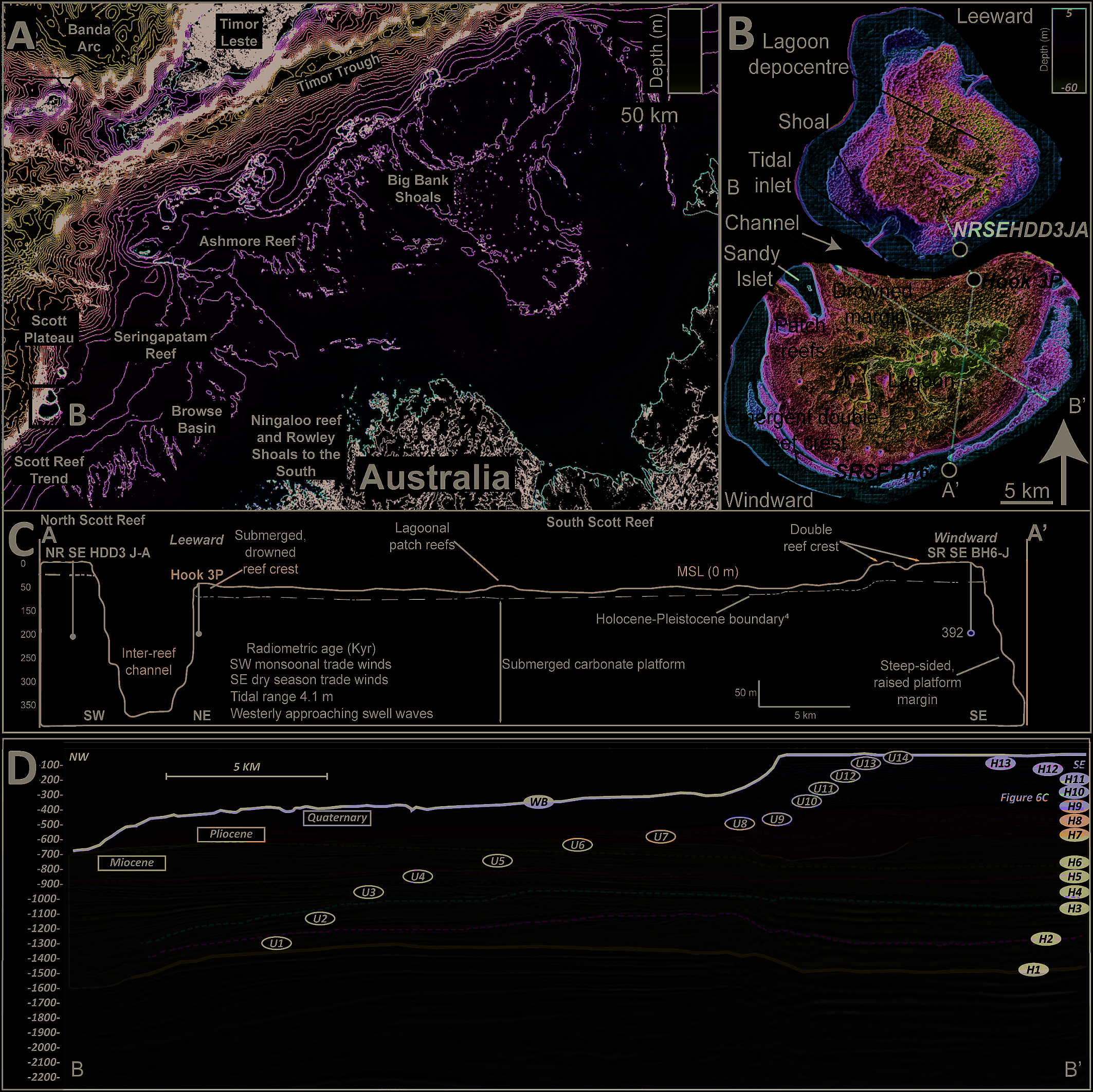
Regional bathymetric map showing Scott Reef's location on Australia's Northwest Shelf relative to nearby reefs and tectonic features.

Researchers used forward stratigraphic modelling to reconstruct how Scott Reef, on Australia's Northwest Shelf, grew and changed shape during the Middle Pleistocene Transition, a period when ice age cycles became longer and more extreme. They found that a major sea-level fall around 1.2 million years ago exposed and karstified the reef, while a later long … Read more…

Geology: Submarine volcanism along shallow ridges did not drive Cryogenian cap carbonate formation

The termination of Neoproterozoic “Snowball Earth” glaciations is marked globally by laterally extensive neritic cap carbonates directly overlying glacial diamictites. The formation of these unique deposits on deglaciation calls for anomalously high CaCO3 saturation. A popular mechanism to account for the source of requisite ocean alkalinity is the shallow-ridge hypothesis, in which initial spreading ridges … Read more…