
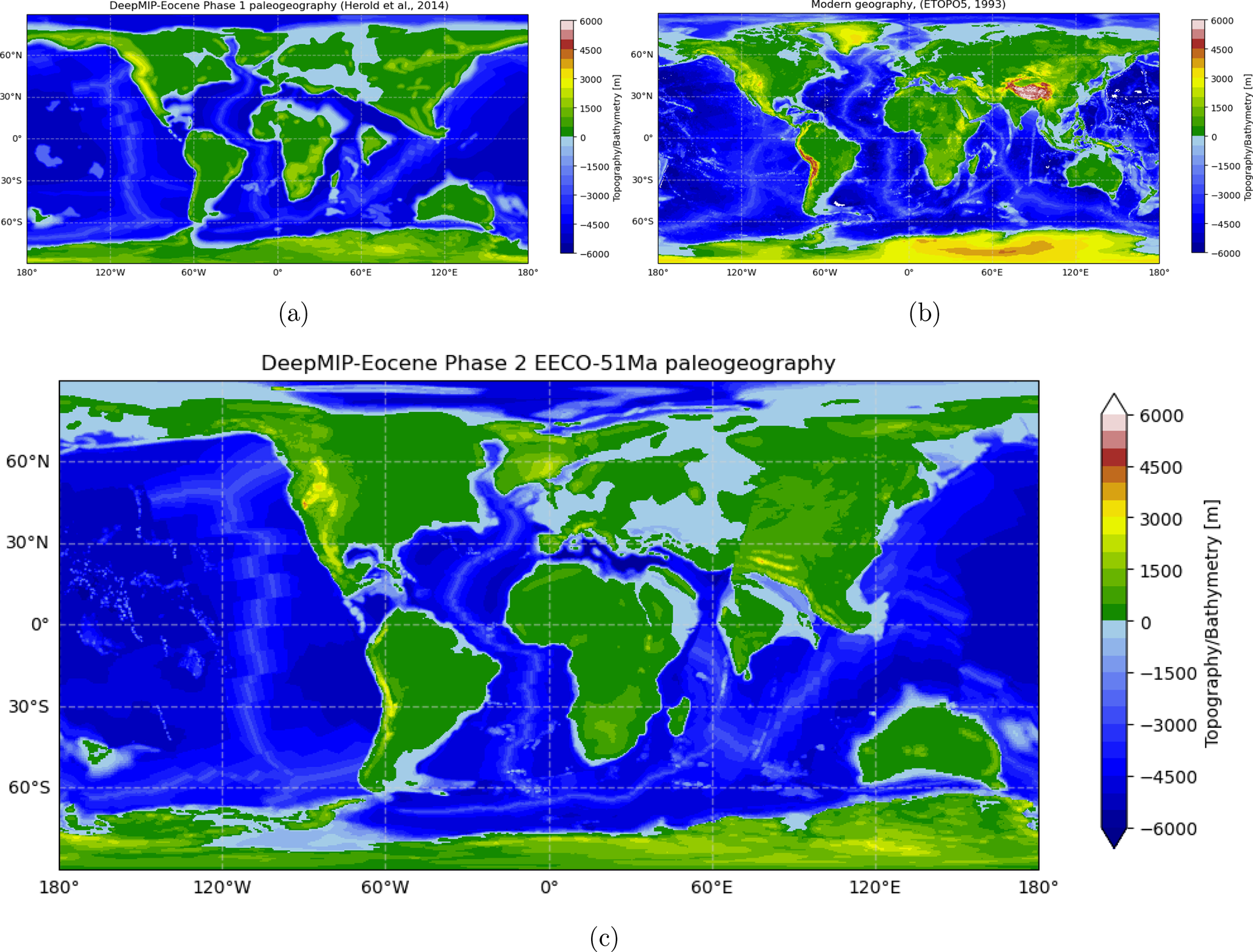
This paper outlines the experimental design for Phase 2 of DeepMIP-Eocene, a project that coordinates climate model simulations of the early Eocene, a period around 56–41 million years ago when global temperatures were far higher than today and carbon dioxide levels were much greater. The design updates the paleogeography, vegetation and carbon dioxide inputs used in earlier work, and sets out a core set of simulations plus optional sensitivity experiments. This framework is intended to help modelling groups compare results consistently, improve comparisons with geological data, and better understand the mechanisms behind extreme past warmth relevant to future climate projections.
Abstract. Warm, high-CO 2 climates of Earth's past provide an opportunity to evaluate climate models under extreme forcing, and to explore mechanisms that lead to such warmth. One such time period is the early Eocene (∼56–41 million years ago), when global mean surface temperatures were ∼15 °C higher than preindustrial, and CO 2 concentrations were ∼1500 ppmv. In this paper we present the experimental design for Phase 2 of the Eocene component of the Deep-time Model Intercomparison project (DeepMIP-Eocene-p2). The aim is to provide a framework for modelling groups to carry out a common set of simulations, thereby facilitating exploration of inter-model dependencies. The focus is on the early Eocene Climatic Optimum (EECO, ∼53.3–49.1 million years ago). Relative to Phase 1 of DeepMIP-Eocene, we provide a new paleogeography (topography, bathymetry) derived from several recent independent reconstructions that focused on different regions, a new vegetation distribution derived by merging paleobotanical data with vegetation model simulations, and a new CO 2 specification derived from recent re-evaluations of proxy data. The core set of simulations consists of a preindustrial control, an abrupt increase to 4× preindustrial CO 2 concentration from this preindustrial control, a standard control EECO simulation at 5× preindustrial CO 2 concentration, and an EECO simulation with preindustrial CO 2 concentration. In addition to these core simulations, we suggest a suite of optional sensitivity studies, which allow the impact of various factors to be explored, such as topography/bathymetry, greenhouse gases, land-surface parameters, astronomical and solar forcings, and internal model parameters. The updated boundary conditions and guidance on initialisation and spinup in Phase 2 will allow more robust model-data comparisons, more accurate insights into mechanisms influencing early Eocene climate, and increased relevance for informing future climate change projections.
Code and data: Zenodo: 10.5281/zenodo.21065940 | Zenodo: 10.5281/zenodo.21066096 | Zenodo: 10.5281/zenodo.17887456 | Zenodo: 10.5281/zenodo.17899194 | Zenodo: 10.5281/zenodo.20769472

